Gentle TMJ physical therapy exercises can help improve jaw mobility, reduce muscle tightness, and make everyday movements such as chewing, speaking, and opening the mouth more comfortable. Common exercises focus on controlled jaw opening, relaxed movement, tongue positioning, and gentle resistance rather than forcing the joint through a large range of motion. The right exercises depend on the cause and severity of your TMJ symptoms, so they should be performed slowly and stopped if they increase pain, locking, or other symptoms.
This guide explains several commonly used jaw exercises, how to perform them safely, how often to practice them, and when exercise alone may not be enough.
What Are TMJ Physical Therapy Exercises?
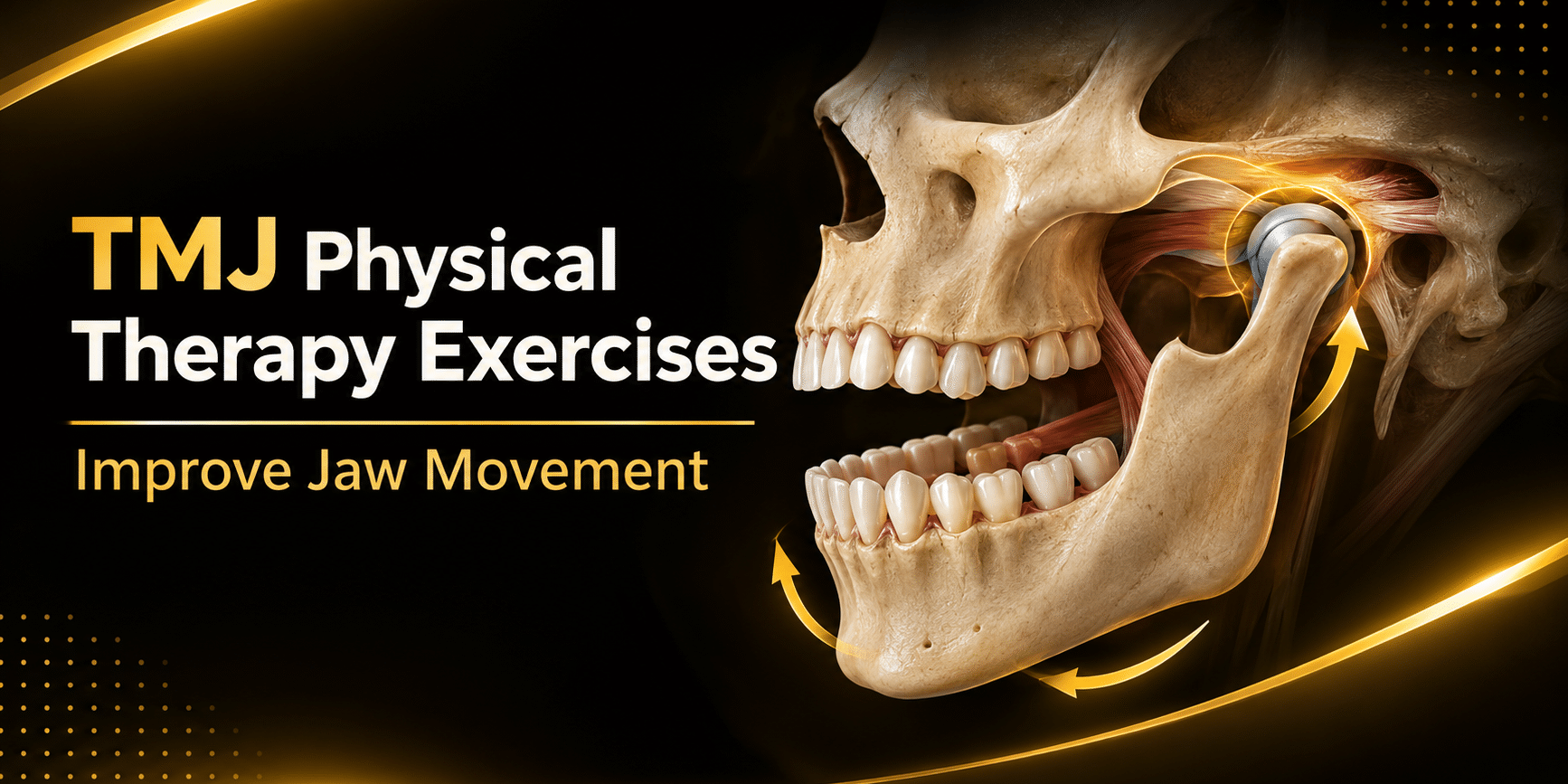
TMJ physical therapy exercises are controlled movements designed to improve the function of the temporomandibular joints and the muscles surrounding the jaw. The temporomandibular joints connect the lower jaw to the skull and allow movements needed for chewing, talking, swallowing, and facial expressions.
When these joints or their surrounding muscles become irritated or overloaded, jaw movement may feel stiff, restricted, uneven, or uncomfortable. Some people also notice clicking, popping, muscle fatigue, headaches, or difficulty opening the mouth fully.
Exercises used for TMJ problems generally aim to improve movement without placing unnecessary stress on the joint. Depending on the individual’s symptoms, a dentist or physical therapist may recommend mobility exercises, stretching, coordination exercises, posture work, or gentle strengthening.
For people who need more than home exercises, professional TMJ therapy can help determine whether the symptoms are related primarily to the jaw joint, chewing muscles, bite-related factors, clenching, or another condition.
How TMJ Exercises May Improve Jaw Movement
The jaw is controlled by several muscles that work together to open, close, and move the mandible from side to side. If these muscles become tense or their movement becomes poorly coordinated, the jaw may not move smoothly.
Appropriate physical therapy TMJ exercises may help by encouraging controlled movement and reducing unnecessary muscle tension. They can also help a person become more aware of habits such as holding the teeth together when the jaw should be relaxed.
The goal is not to stretch the jaw as far as possible. Instead, the emphasis is on comfortable, controlled movement.
| Exercise goal | What the exercise may focus on |
| Improve opening | Controlled jaw movement |
| Reduce muscle tension | Relaxed jaw positioning |
| Improve coordination | Smooth opening and closing |
| Support side-to-side movement | Gentle lateral jaw control |
| Improve awareness | Resting jaw position |
| Support recovery | Gradual return to comfortable movement |
Results vary because TMJ symptoms can have different causes. An exercise that feels helpful for one person may be inappropriate for another, particularly when significant inflammation, joint damage, locking, or acute pain is present.
1. Relaxed Jaw Position Exercise
One of the simplest tmj therapy exercise techniques is learning to keep the jaw relaxed when it is not being used.
Sit upright and allow your shoulders to relax. Keep your tongue resting gently against the roof of your mouth, with the teeth slightly apart. Avoid clenching or pressing the teeth together.
Hold this relaxed position for several seconds while breathing normally. Repeat it several times throughout the day.
This exercise is less about strengthening the jaw and more about reducing unnecessary muscle activity. Many people unconsciously keep their teeth together during concentration, computer work, driving, or stressful situations. Becoming aware of this habit can help reduce repetitive strain on the chewing muscles.
2. Controlled Jaw Opening
Controlled opening is commonly used to encourage smoother jaw movement.
Start with your tongue resting gently against the roof of your mouth. Slowly open your mouth while keeping the movement comfortable. Try to keep the lower jaw moving straight down rather than allowing it to shift significantly to one side.
Pause briefly at a comfortable opening point, then slowly close your mouth.
The movement should be controlled rather than forced. If your jaw consistently deviates to one side, catches, or becomes painful during the exercise, stop and discuss the symptom with a dental professional.
This type of movement can be particularly useful for people who feel that their jaw has become stiff or that opening has become less coordinated.
3. Tongue-Up Jaw Exercise
Tongue positioning can provide a simple way to practice controlled jaw movement.
Place the tip of your tongue gently against the roof of your mouth behind the upper front teeth. Keeping the tongue in contact with the palate, slowly open and close your mouth within a comfortable range.
The purpose is to encourage controlled movement while limiting unnecessary jaw tension.
Do not press the tongue forcefully against the palate. The exercise should feel gentle and coordinated rather than strenuous.
If you experience pain, significant clicking accompanied by discomfort, or a sensation that the jaw is catching, reduce the movement or stop the exercise.
4. Gentle Resisted Opening
Some patients may benefit from very light resistance exercises, but these should not be treated as a universal solution for every TMJ problem.
To practice gentle resisted opening, place a finger or thumb under the chin. Begin opening the mouth while applying only minimal resistance with your hand. The jaw should move slightly against the resistance without straining.
Hold the contraction briefly, then relax.
The resistance should be light. This is not a test of how much force your jaw can produce. Excessive resistance may increase muscle soreness or aggravate an already irritated joint.
If you have acute TMJ pain, limited opening, a history of jaw locking, or recently had dental or jaw surgery, ask your dentist or physical therapist whether resisted exercises are appropriate before adding them to your routine.
5. Gentle Resisted Closing
A similar approach can be used to practice controlled closing.
Place your hand under the chin and open the mouth slightly. Apply gentle upward resistance while slowly closing the jaw.
The movement should remain smooth and controlled.
This exercise may be used as part of a broader rehabilitation program when a professional determines that strengthening or coordination work is appropriate. It should not be performed aggressively or repeatedly if it causes pain.
The purpose of physical therapy TMJ exercises is controlled rehabilitation, not maximum resistance training.
6. Side-to-Side Jaw Movement
The jaw also needs to move from side to side for normal chewing.
Start with your mouth slightly open and relaxed. Slowly move your lower jaw toward one side, then return it to the center. Repeat on the opposite side.
Keep the movement small at first. You do not need to move the jaw as far as possible.
As control improves, the range may gradually increase if the movement remains comfortable.
Side-to-side exercises can be useful for people who feel stiffness when chewing or who notice that their jaw does not move evenly. However, persistent deviation, pain, or catching may require professional assessment rather than simply increasing the number of repetitions.
7. Gentle Jaw Stretch
A gentle stretch may help people who have muscular tightness and restricted movement, but stretching should never be forced.
Open the mouth slowly until you feel a mild stretch without significant pain. Hold the position briefly, then return to a relaxed position.
The sensation should remain mild. Avoid pushing the jaw farther open with your fingers unless a qualified professional has specifically shown you how to perform a particular assisted stretch.
Forcing a tight or painful jaw open can aggravate symptoms instead of improving mobility.
8. Chin Tuck and Posture Exercise
Jaw function is not completely separate from the muscles of the neck and upper body. Poor posture can contribute to changes in head and neck positioning, which may affect how the jaw muscles work.
A simple chin tuck can help develop awareness of a more neutral head position.
Sit or stand comfortably with your shoulders relaxed. Gently draw your chin backward, as though making a small double-chin movement. Do not tilt your head downward. Hold briefly and relax.
This exercise should feel subtle. It is not intended to strain the neck.
Posture exercises may be included alongside other TMJ rehabilitation techniques when a clinician identifies neck or upper-body factors that may be contributing to symptoms.
9. Jaw Relaxation With Slow Breathing
Muscle tension can make jaw discomfort more noticeable, especially when clenching occurs during stressful periods.
Sit comfortably and allow your shoulders to drop. Keep the teeth slightly apart and the jaw relaxed. Take slow, comfortable breaths while maintaining this resting position.
Focus on avoiding unnecessary tightening of the jaw muscles.
Although breathing exercises do not treat every cause of TMJ disorder, relaxation can be useful as part of a broader approach to reducing clenching and muscle tension.
When Should You Stop TMJ Exercises?
Mild stretching or muscle awareness can be normal, but significant or worsening symptoms deserve attention.
Stop an exercise and seek professional advice if you experience new or increasing jaw pain, significant swelling, repeated locking, inability to open or close the mouth normally, or symptoms that continue to worsen after exercise.
A sudden change in jaw function should not automatically be treated with more stretching.
The same principle applies to persistent clicking. Clicking without pain is not necessarily an emergency, but clicking accompanied by pain, locking, or changes in jaw movement should be evaluated.
For patients experiencing symptoms that require a broader treatment plan, TMJ physical therapy treatments and techniques may provide additional information about professional approaches beyond home exercises.
TMJ Exercises vs Professional Physical Therapy
Home exercises can be useful, but professional therapy offers something that a general exercise list cannot: an assessment of how your jaw actually moves.
A dentist or physical therapist may evaluate your jaw opening, side-to-side movement, chewing muscles, neck posture, joint sounds, tenderness, and functional limitations. Based on those findings, the exercise program can be adjusted.
| Home exercises | Professional therapy |
| Can be performed independently | Guided by a trained professional |
| Focus on simple movements | Can include individualized techniques |
| Useful for ongoing mobility work | Includes assessment and progression |
| Convenient for daily practice | Can identify movement problems |
| May support symptom management | May address contributing factors more specifically |
For people with persistent symptoms, physical therapy for TMJ syndrome can be considered as part of a professionally guided treatment approach.
What Other TMJ Treatments May Be Used?
Exercises are only one part of TMJ care. Depending on the cause of symptoms, a dentist may recommend other conservative or supportive approaches.
These can include behavior modification, jaw-rest strategies, splint or appliance therapy, physical therapy, stress-management techniques, or other treatments selected according to the patient’s symptoms.
For example, TMJ splint therapy may be discussed when an oral appliance is considered appropriate. In other situations, different therapeutic techniques may be explored.
Treatment should be individualized rather than based on a single technique that is expected to work for everyone.
When to See a Dentist About TMJ Symptoms
Home exercises are not a substitute for evaluation when symptoms are persistent or significant.
Consider professional assessment if your jaw pain continues, your mouth opening is becoming more limited, chewing is difficult, or the jaw repeatedly locks. Evaluation is also appropriate when symptoms interfere with sleep, eating, speaking, or normal daily activities.
A dentist can help determine whether the symptoms are consistent with a temporomandibular disorder or whether another dental or medical issue needs consideration.
The TMJ therapy center at The Advanced Dental Center of Cedar Knolls can also be a resource for patients seeking evaluation and treatment options for ongoing TMJ concerns.
Frequently Asked Questions About TMJ Physical Therapy Exercises
What is the best exercise for TMJ pain?
There is no single best exercise for every person with TMJ pain. Gentle controlled opening, relaxed jaw positioning, and carefully performed mobility exercises are commonly used, but the appropriate routine depends on the cause of the symptoms.
Can TMJ exercises improve jaw opening?
They may help improve controlled jaw movement and mobility when muscle tightness or movement coordination contributes to limited opening. However, significant restriction or locking should be professionally evaluated rather than treated by forcing the jaw open.
How often should I do TMJ physical therapy exercises?
Frequency depends on the exercise and your symptoms. Gentle movements may be practiced regularly, but excessive repetitions can irritate the jaw. Follow the schedule provided by your dentist or physical therapist when you have an individualized program.
Should TMJ exercises hurt?
Exercises should generally be comfortable or involve only a mild stretching sensation. Sharp, significant, or increasing pain is a reason to stop the exercise and seek professional guidance.
Can jaw exercises get rid of TMJ clicking?
Not necessarily. Clicking can have different causes, and exercise may improve movement without eliminating the sound. Clicking accompanied by pain, locking, or restricted movement should be evaluated.
Are TMJ exercises safe for everyone?
Not every exercise is appropriate for every TMJ condition. People with significant pain, jaw locking, recent surgery, major restriction in movement, or other concerning symptoms should seek professional advice before starting a new exercise routine.
Can physical therapy help with TMJ disorders?
Physical therapy may help selected patients improve jaw and neck movement, muscle function, and mobility. A professional assessment can help determine whether physical therapy is suitable and which techniques are appropriate.
Conclusion
The right tmj physical therapy exercises can support smoother jaw movement, reduce unnecessary muscle tension, and improve everyday jaw function for some people. Gentle controlled opening, relaxed jaw positioning, side-to-side movement, posture work, and carefully selected strengthening exercises are commonly used approaches.
The key is to avoid forcing the joint or treating exercise as a one-size-fits-all solution. If pain, locking, restricted movement, or other persistent symptoms are present, professional evaluation can help identify the underlying problem and guide treatment.
With an appropriate exercise routine and attention to habits such as clenching and excessive jaw use, many patients can work toward more comfortable jaw movement. If symptoms continue or interfere with normal activities, speak with a dental professional about the most appropriate next step.