Choosing dental implants is a major step toward restoring your smile, confidence, and oral health. However, many patients are surprised to learn that there isn’t just one kind of implant. In fact, there are several different types of dental implants, and each is designed to address specific clinical situations.
Some people need to replace a single missing tooth, while others have multiple missing teeth or even an entire arch. Bone density, gum health, medical history, and long-term treatment goals also influence which implant option is most appropriate. Understanding the available dental implants types helps patients have more informed conversations with their dentist and better understand why one treatment may be recommended over another.
Modern implant dentistry has advanced significantly over the past few decades. Today’s implants are stronger, more predictable, and more natural-looking than ever before. With proper planning and professional care, dental implants can restore chewing function, improve speech, preserve jawbone health, and provide long-lasting stability.
This guide explains the different types of dental implants, how each works, their advantages, and the factors dentists consider when recommending a treatment plan.
Why Understanding Dental Implant Types Matters
Many patients assume every dental implant procedure is essentially the same. While the basic concept remains consistent, replacing missing tooth roots with biocompatible titanium or ceramic implants, the design, placement technique, and restoration can vary considerably.
Choosing the correct implant type affects:
- Long-term stability.
- Healing time.
- Bone preservation.
- Overall function.
- Smile aesthetics.
- Treatment complexity.
Rather than selecting an implant based solely on preference, dentists evaluate several clinical factors before recommending the most suitable solution.
These include:
- Number of missing teeth.
- Jawbone volume and density.
- Gum health.
- Bite alignment.
- Overall medical history.
- Lifestyle habits such as smoking.
- Long-term restorative goals.
Every patient’s mouth is unique, which is why implant treatment is always customized.
How Dental Implants Work
Before discussing the various dental implants types, it helps to understand how every implant functions.
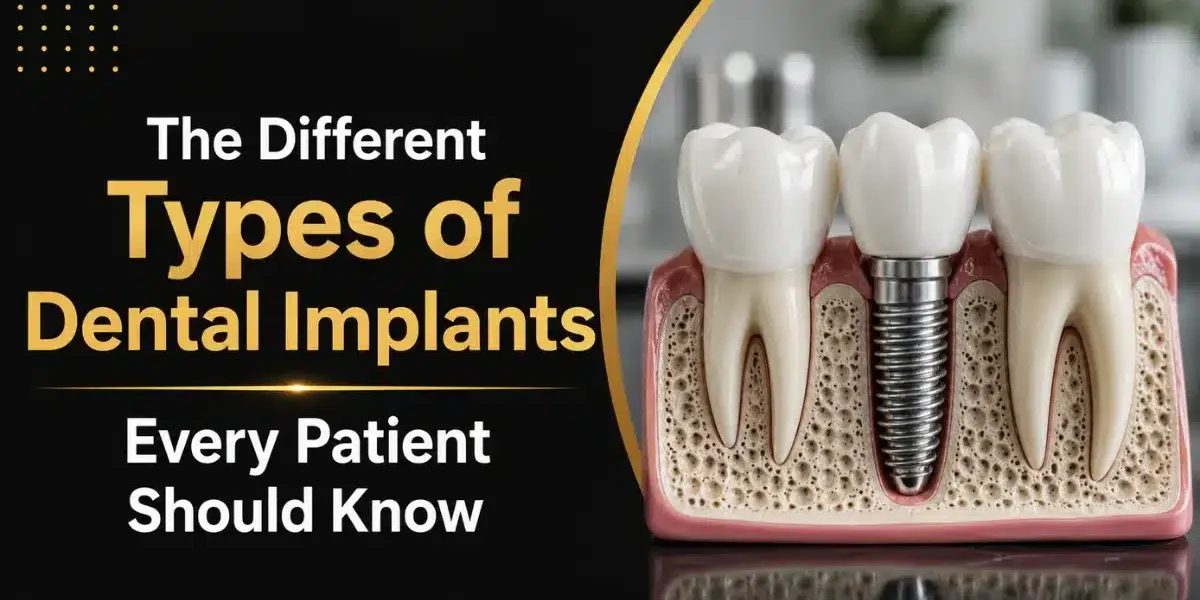
A dental implant consists of three primary components.
| Component | Purpose |
| Implant Fixture | Artificial root placed inside the jawbone |
| Abutment | Connector that joins the implant and restoration |
| Crown, Bridge, or Denture | Visible replacement tooth or teeth |
The implant fixture acts as an artificial tooth root. After placement, it gradually bonds with the surrounding jawbone through a natural healing process called osseointegration. This creates exceptional stability and allows the restoration to function much like a natural tooth.
If you’re unfamiliar with how implant treatment progresses from consultation to final restoration, our guide on how long it takes to get dental implants explains each stage of the treatment timeline in detail.
What Are the 3 Types of Dental Implants?
One of the most common questions patients ask is, “What are the 3 types of dental implants?”
While implant dentistry includes numerous variations, the three primary categories are:
- Endosteal dental implants
- Subperiosteal dental implants
- Zygomatic dental implants
Each serves a different purpose depending on bone availability and treatment requirements.
Let’s examine each option in more detail.
1. Endosteal Dental Implants
Endosteal implants are the most frequently used type of dental implants worldwide.
They are surgically placed directly into the jawbone and become securely integrated during healing. Once the implant bonds with the bone, an abutment and custom restoration are attached.
Because they closely mimic natural tooth roots, endosteal implants provide excellent stability and long-term function.
They are commonly recommended for patients who:
- Have healthy jawbone density.
- Need to replace one or several missing teeth.
- Maintain good oral hygiene.
- Are healthy enough for routine implant surgery.
Most single-tooth implants, implant-supported bridges, and full-arch restorations utilize endosteal implants.
Advantages of Endosteal Implants
Patients often prefer this option because it offers several important benefits.
- Excellent long-term success rates.
- Strong chewing ability.
- Natural appearance.
- Helps preserve jawbone volume.
- Suitable for single or multiple missing teeth.
For most patients with adequate bone support, endosteal implants remain the gold standard in modern implant dentistry.
2. Subperiosteal Dental Implants
Subperiosteal implants differ significantly from traditional endosteal implants.
Instead of being inserted into the jawbone, these implants rest on top of the bone but beneath the gum tissue. A lightweight metal framework supports replacement teeth while remaining anchored under the gums.
Years ago, subperiosteal implants were commonly used for patients who lacked sufficient jawbone height.
Today, advances in bone grafting have reduced their use considerably, but they may still be considered in select situations where traditional implant placement isn’t appropriate.
Patients who may benefit include those who:
- Have significant bone loss.
- Cannot undergo bone grafting.
- Need an alternative restorative solution.
- Have medical conditions limiting extensive surgery.
Although less common today, subperiosteal implants continue to play a role in carefully selected cases.
3. Zygomatic Dental Implants
Zygomatic implants are the least common but most specialized of the major different types of dental implants.
Rather than anchoring into the upper jawbone, these longer implants are secured within the cheekbone, known as the zygomatic bone.
Because the cheekbone provides excellent structural support, this technique allows some patients with severe upper jaw bone loss to receive implants without extensive bone grafting.
Zygomatic implants are generally reserved for:
- Severe upper jaw bone loss.
- Complex full-mouth rehabilitation.
- Patients who cannot receive conventional implants.
- Advanced restorative cases managed by experienced implant surgeons.
Their placement requires advanced surgical training and careful treatment planning.
Comparing the Three Main Implant Types
Understanding the differences becomes easier when viewed side by side.
| Implant Type | Placement Location | Best For | Most Common? |
| Endosteal | Inside the jawbone | Most patients | Yes |
| Subperiosteal | On top of jawbone beneath gums | Limited bone volume | Occasionally |
| Zygomatic | Cheekbone | Severe upper jaw bone loss | Rare |
Each option has specific clinical indications, making professional evaluation essential before deciding which treatment is appropriate.
Other Ways Dental Implants Are Classified
Although patients often ask about the three primary implant categories, dentists also classify implants according to the restoration they support.
This approach helps determine how many implants are needed and what type of prosthetic restoration will be attached.
Common restorative options include:
- Single-tooth implants.
- Implant-supported bridges.
- Implant-supported dentures.
- Full-arch implant restorations.
Each option serves different treatment goals depending on how many teeth need replacement.
Single-Tooth Dental Implants
A single-tooth implant replaces one missing tooth without affecting the neighboring teeth.
The implant functions independently and supports an individual custom-made crown designed to match the surrounding natural teeth.
This option is often considered ideal because it preserves healthy adjacent teeth while maintaining jawbone stimulation in the missing tooth area.
Patients frequently choose single implants when they have lost one tooth due to injury, decay, or fracture.
Implant-Supported Bridges
When several neighboring teeth are missing, placing an implant for every individual tooth may not always be necessary.
Instead, two or more implants can support a custom dental bridge that replaces multiple teeth simultaneously.
Implant-supported bridges provide several benefits over traditional bridges because they don’t rely on grinding down healthy adjacent teeth for support.
They also distribute chewing forces more naturally across the jawbone.
Implant-Supported Dentures
For patients who have lost most or all of their teeth, implant-supported dentures offer a more stable and comfortable alternative to traditional removable dentures.
Unlike conventional dentures that rest directly on the gums, implant-supported dentures attach securely to dental implants placed in the jawbone. This added stability minimizes movement during speaking and eating while also helping preserve the underlying bone.
Depending on the treatment plan, two to six implants may be used to support a complete denture.
Patients often choose this option because it provides:
- Improved chewing ability.
- Greater confidence while speaking.
- Reduced denture movement.
- Better comfort than traditional dentures.
- Enhanced jawbone preservation.
Implant-supported dentures may be removable for cleaning or permanently fixed in place, depending on the patient’s needs and the dentist’s recommendation.
Full-Arch Dental Implants
For individuals missing all teeth in the upper or lower jaw, full-arch implant systems provide one of the most comprehensive restorative solutions available.
Rather than replacing every missing tooth with an individual implant, several strategically positioned implants support an entire arch of replacement teeth.
Two of the most common approaches include:
- All-on-4
- All-on-6
Both techniques restore function while minimizing the number of implants required.
All-on-4 Dental Implants
All-on-4 treatment uses four carefully positioned implants to support a complete upper or lower arch.
The back implants are usually placed at an angle, allowing many patients with moderate bone loss to avoid extensive bone grafting.
Advantages include:
- Fewer implants required.
- Excellent stability.
- Faster treatment planning.
- Natural-looking smile.
- Strong chewing function.
Many patients receive a temporary restoration shortly after surgery while the implants continue healing beneath the gums.
All-on-6 Dental Implants
All-on-6 follows the same principle but uses six implants instead of four.
The additional implants distribute biting forces more evenly and may provide additional support for patients with higher bite forces or greater functional demands.
Your dentist determines whether four or six implants are most appropriate after evaluating your bone quality, jaw anatomy, and overall oral health.
Titanium vs. Zirconia Dental Implants
Another way dentists classify different types of dental implants is by the material used to manufacture the implant.
Today, the two primary materials are titanium and zirconia.
| Feature | Titanium Implants | Zirconia Implants |
| Material | Medical-grade titanium | Ceramic zirconia |
| Clinical History | Several decades | Growing clinical evidence |
| Strength | Excellent | Excellent |
| Biocompatibility | Outstanding | Outstanding |
| Appearance | Hidden beneath gums | White-colored material |
Titanium Implants
Titanium remains the most widely used implant material worldwide.
Its long history of clinical success, exceptional strength, and ability to bond naturally with bone have made it the standard choice for most implant procedures.
Millions of successful implant restorations have been completed using titanium implants over several decades.
Zirconia Implants
Zirconia implants have become increasingly popular among patients seeking metal-free restorative options.
Their white color may provide cosmetic advantages in certain situations, particularly for patients with very thin gum tissue.
Although zirconia continues to gain popularity, titanium currently has the longest track record supported by extensive clinical research.
Which Type of Dental Implant Is Best?
Patients often ask whether one implant type is better than another.
The answer depends entirely on the individual’s oral health and treatment goals.
There is no universal “best” implant because every patient presents different clinical needs.
Dentists evaluate several factors before recommending the most appropriate solution.
These include:
- Number of missing teeth.
- Bone volume.
- Gum health.
- Bite alignment.
- Medical history.
- Lifestyle habits.
- Long-term expectations.
For most healthy adults with adequate jawbone, endosteal implants remain the preferred choice because of their excellent success rates and predictable outcomes.
Patients with more complex situations may require advanced treatment approaches involving additional planning or specialized implant designs.
Factors That Influence Implant Selection
Choosing among the available dental implants types involves much more than simply replacing a missing tooth.
Your dentist performs a comprehensive examination to determine which option offers the greatest long-term success.
Some of the most important considerations include:
Bone Quality
Healthy bone provides the stable foundation required for successful implant integration.
Patients with reduced bone volume may benefit from bone grafting or alternative implant techniques.
Number of Missing Teeth
Replacing one tooth requires a different treatment approach than restoring an entire arch.
Treatment planning always considers both current and future oral health needs.
Overall Health
Certain medical conditions may influence healing following implant placement.
Your dentist reviews your medical history to ensure implant treatment is appropriate and to optimize recovery.
Oral Hygiene
Successful implants depend heavily on long-term plaque control.
Patients who maintain excellent oral hygiene typically experience the best long-term outcomes.
Benefits of Modern Dental Implants
Regardless of the specific type of dental implants selected, modern implant treatment offers numerous advantages compared with traditional tooth replacement options.
Some of the most significant benefits include:
- Restores natural chewing function.
- Helps preserve jawbone density.
- Prevents neighboring teeth from shifting.
- Supports clear speech.
- Looks and feels natural.
- Provides long-term durability.
- Improves overall confidence.
Unlike removable dentures, implants become integrated with the jawbone, providing exceptional stability for everyday activities.
Common Myths About Dental Implant Types
Many misconceptions continue to discourage patients from considering implant treatment.
Let’s separate fact from fiction.
| Myth | Reality |
| Every implant is identical. | Multiple implant types exist for different clinical situations. |
| Everyone needs bone grafting. | Many patients have sufficient bone without additional procedures. |
| Older adults cannot receive implants. | Age alone rarely prevents implant treatment. |
| Implant treatment is only for replacing one tooth. | Implants can replace one tooth, several teeth, or a full arch. |
Understanding these facts allows patients to make informed decisions rather than relying on outdated information.
Maintaining Your Dental Implants
Choosing the right implant is only the beginning.
Long-term success depends on proper maintenance after treatment is complete.
Daily care includes:
- Brushing twice each day.
- Cleaning around the implant thoroughly.
- Using floss or interdental cleaning aids.
- Attending routine dental examinations.
- Receiving regular professional cleanings.
If you’re preparing for implant treatment, learning about recovery is just as important as understanding implant types. Our guide on Are dental implants painful? explains what most patients experience after surgery and how modern techniques help minimize discomfort throughout the healing process.
Proper healing also plays a major role in long-term implant success. Understanding the complete treatment timeline can help you know what to expect before, during, and after surgery. You can learn more in our article on how long it takes to get dental implants, which walks through each stage of the process from consultation to final restoration.
While implants restore missing teeth, many patients also explore cosmetic treatments to enhance their overall smile once treatment is complete. If you’re interested in improving the appearance of your natural teeth alongside your implant restoration, our guide on how to get perfectly white teeth shares practical tips for maintaining a brighter, healthier-looking smile.
Frequently Asked Questions
What are the 3 types of dental implants?
The three primary categories are endosteal implants, subperiosteal implants, and zygomatic implants. Each serves different clinical situations depending on jawbone volume and treatment needs.
Which type of dental implant is most common?
Endosteal implants are by far the most commonly used because they provide excellent long-term stability and are suitable for most patients with healthy jawbone.
Are titanium implants better than zirconia?
Both materials are highly biocompatible. Titanium has the longest history of clinical success, while zirconia offers a metal-free alternative for selected patients.
Can one implant replace several teeth?
Yes. Implant-supported bridges and full-arch restorations allow multiple missing teeth to be replaced using fewer implants.
Does everyone qualify for every type of implant?
No. Bone quality, oral health, medical history, and the number of missing teeth all influence which implant option is most appropriate.
How does my dentist choose the right implant?
Your dentist evaluates bone density, gum health, bite alignment, overall health, and long-term treatment goals before recommending the most suitable implant type.
Final Thoughts
Understanding the different types of dental implants helps patients feel more confident when exploring tooth replacement options. While endosteal, subperiosteal, and zygomatic implants all serve the same overall purpose of replacing missing teeth, each is designed for specific clinical situations.
Advances in implant dentistry now allow dentists to restore everything from a single missing tooth to a complete arch with highly predictable, long-lasting results. The best treatment isn’t determined by choosing the newest or most advanced implant, but by selecting the option that best matches your oral health, bone structure, and functional needs.
A comprehensive dental evaluation is the first step toward identifying the ideal solution. By working closely with an experienced implant dentist and following a personalized treatment plan, patients can enjoy improved function, restored confidence, and a healthier smile that lasts for many years.