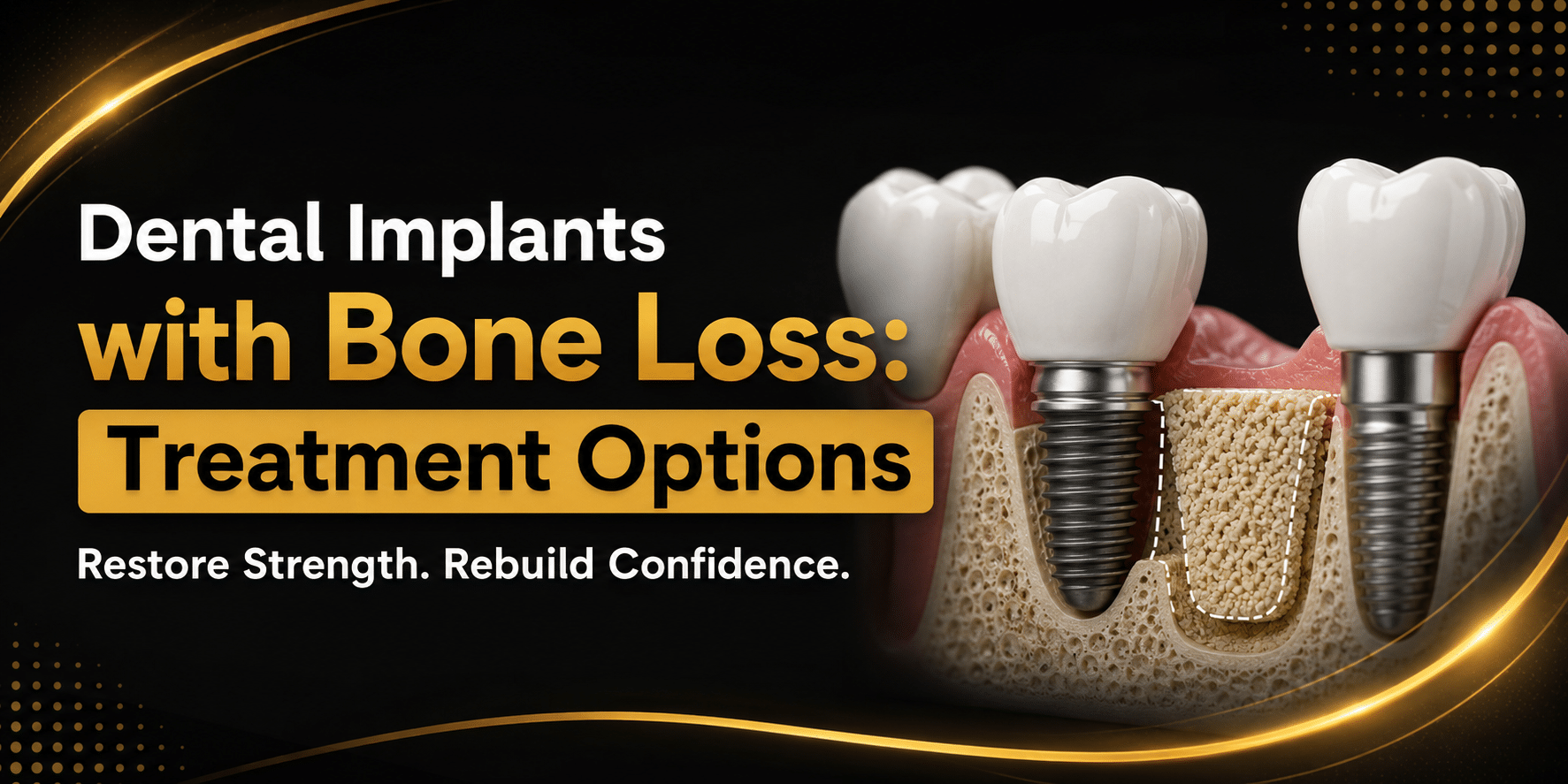
Losing bone in the jaw does not automatically mean you cannot have dental implants. Dental implants with bone loss are often possible, but the treatment plan depends on how much bone remains, where the bone loss has occurred, and the condition of the surrounding tissues. In many cases, a dentist or oral surgeon can rebuild or work around deficient bone using procedures such as bone grafting, ridge augmentation, or a sinus lift. This guide explains why bone loss occurs, how it affects implant placement, what treatment options are available, and what patients can expect during the process.
Why Bone Loss Happens After Tooth Loss
The jawbone needs stimulation from natural tooth roots to maintain its volume and density. When a tooth is removed, that stimulation disappears. The body gradually remodels the bone in the area, and the ridge may become narrower and shorter over time.
This process is known as alveolar bone loss, and it can make implant treatment more challenging.
Bone loss can also occur before a tooth is removed. Common causes include advanced gum disease, severe infection, trauma, untreated dental problems, and certain medical conditions that affect bone health.
The longer a missing tooth remains unreplaced, the greater the possibility of changes to the shape and volume of the jawbone. However, the amount and speed of bone loss vary considerably from person to person.
How Bone Loss Affects Dental Implant Treatment
A dental implant needs sufficient bone for stability. During implant placement, the implant is positioned inside the jawbone, where it eventually becomes integrated with the surrounding bone through a process called osseointegration.
If there is not enough bone, several problems may arise.
The implant may not have enough initial stability for predictable healing. There may also be insufficient bone width or height to fully surround the implant. In some cases, placing an implant without addressing significant bone deficiency could increase the risk of complications.
This is why implant planning is more than simply checking whether a tooth is missing. The dentist must evaluate the three-dimensional anatomy of the jaw and determine whether the available bone can support an implant safely.
Modern implant planning commonly involves dental imaging, including three-dimensional scans such as cone-beam computed tomography (CBCT). These images allow the dental team to assess bone dimensions and identify important anatomical structures before treatment begins.
Can You Get Dental Implants With Bone Loss?
Yes, can you get dental implants with bone loss is a question with a generally encouraging answer: many patients can still receive implants after appropriate evaluation and treatment.
The key issue is not simply whether bone loss exists, but whether there is enough healthy bone in the right location to achieve stable implant placement.
For some patients, the remaining bone is sufficient to place an implant without additional bone treatment. For others, bone must first be rebuilt or the implant approach must be modified.
The treatment may involve:
- Bone grafting to increase available bone
- Ridge augmentation to restore width or height
- A sinus lift for implants in the upper back jaw
- Carefully planned implant placement using the existing anatomy
- Alternative implant designs or techniques in selected cases
A dental professional can determine which approach is appropriate after reviewing your oral health, imaging, medical history, and treatment goals.
Bone Graft for Dental Implant Treatment
A bone graft for dental implant treatment is one of the most common ways to address inadequate bone volume.
Bone grafting adds bone or a bone-supporting material to an area where the jaw has lost volume. Over time, the grafted area can develop enough new bone or structural support to make implant placement more predictable.
The material used for grafting can come from different sources. Depending on the situation, a dentist or oral surgeon may use the patient’s own bone, donated human bone, animal-derived material, or synthetic grafting materials.
The choice depends on the location of the defect, the amount of augmentation needed, the clinician’s treatment approach, and the patient’s individual circumstances.
How Bone Grafting Works
The basic process involves placing graft material into the area of bone deficiency and protecting it while healing occurs. In some cases, a membrane or other barrier material is used as part of guided bone regeneration.
The goal is to create a stronger and more suitable foundation for an implant.
Bone grafting does not necessarily mean that implant treatment will take place immediately. Depending on the type and extent of grafting, the area may need time to heal before the implant is placed.
In other cases, an implant can be placed at the same time as a smaller graft when sufficient natural bone remains to provide initial implant stability.
The appropriate timing is determined on an individual basis.
Ridge Augmentation for Narrow or Resorbed Jawbone
Some patients have adequate bone height but not enough width to accommodate an implant comfortably. This can happen after tooth loss because the jaw ridge gradually becomes narrower.
A ridge augmentation procedure can be used to increase the width or height of the affected area.
The exact technique depends on the shape and size of the defect. A grafting material may be placed along the deficient portion of the ridge and allowed to heal before implant placement.
Ridge augmentation can be particularly useful when bone has become thin in the front portion of the jaw, where appearance is also an important consideration.
The dentist must consider both the functional requirements of the implant and the shape of the gum and bone that will surround the final restoration.
Sinus Lift for Bone Loss in the Upper Jaw
Bone loss in the upper back jaw presents a special challenge because the maxillary sinus sits above the roots of the upper molars and premolars.
After these teeth are lost, the bone in this area can become thinner while the sinus may gradually expand downward. This can leave limited vertical bone height for implant placement.
A sinus lift, also called sinus augmentation, can increase the available bone height in this region.
During the procedure, the sinus membrane is carefully moved upward, and graft material is placed beneath it. The additional space can eventually develop into a stronger foundation for dental implants.
There are different sinus lift approaches, and the technique selected depends largely on the amount of bone that remains and the implant plan.
When Is a Sinus Lift Needed?
A sinus lift may be considered when there is insufficient vertical bone in the upper posterior jaw for predictable implant placement.
It is not automatically required for everyone with upper-jaw bone loss. Three-dimensional imaging helps the clinician determine the remaining bone height, sinus anatomy, and safest treatment approach.
In selected cases, an implant may be placed during the same procedure. In other situations, the sinus augmentation is completed first and the implant is placed after healing.
Dental Implants Without Bone Grafting
Not every patient with bone loss needs a graft.
Sometimes the remaining bone is sufficient for implant placement even though some bone has been lost. The implant may be positioned in an area with adequate bone volume, depending on the anatomy and restoration being planned.
The implant’s size and position can also influence the treatment plan.
For example, a patient may have enough bone for a narrower or shorter implant in a carefully selected situation. However, implant dimensions should never be chosen simply to avoid grafting. The goal is to achieve a stable, functional, and maintainable result while respecting the patient’s anatomy.
A thorough examination is necessary before deciding whether grafting can be avoided.
Alternative Implant Approaches for Severe Bone Loss
When bone loss is extensive, conventional implant placement may be more difficult. In selected patients, specialized approaches may be considered.
Short Dental Implants
Short implants can sometimes be useful when vertical bone height is limited. Their suitability depends on factors such as the remaining bone, implant location, bite forces, and overall treatment plan.
They are not appropriate for every patient, and their use should be based on careful clinical assessment rather than bone height alone.
Tilted or Angled Implants
In certain full-arch treatment plans, implants may be positioned at carefully planned angles to make use of available bone while avoiding certain anatomical structures.
This approach is highly technique-sensitive and is generally considered as part of a comprehensive implant restoration rather than as a solution for every case of bone loss.
Zygomatic Implants
For some patients with severe bone loss in the upper jaw, specially designed implants that anchor into the cheekbone, known as zygomatic implants, may be considered.
These are advanced procedures that require specialized training and careful planning. They are generally reserved for specific situations where conventional implants and standard grafting approaches may not be suitable or desirable.
The appropriate option depends on the patient’s anatomy and overall oral health.
Bone Loss and Dental Implants: What Determines Treatment?
There is no single treatment that works for every person with bone loss. Several factors influence the decision.
| Factor | Why It Matters |
| Amount of bone loss | Determines whether enough bone remains for implant stability |
| Bone width | Helps determine whether the implant can be fully supported |
| Bone height | Particularly important in the upper back jaw |
| Location of missing tooth | Different areas have different anatomical limitations |
| Gum health | Healthy supporting tissues are important for implant treatment |
| Existing infection | Active dental infection may need treatment before implant placement |
| Sinus anatomy | Can affect implant placement in the upper posterior jaw |
| Overall health | Healing and surgical risk can be affected by general health |
| Smoking habits | Smoking can negatively affect healing and implant outcomes |
| Oral hygiene | Long-term implant health depends on good plaque control |
This assessment helps the dental team create a treatment plan based on the patient’s actual anatomy rather than using a one-size-fits-all approach.
What Happens Before Implant Placement?
Treatment usually begins with a detailed dental evaluation.
The dentist may examine your remaining teeth, gums, bite, jawbone, and the area where the tooth is missing. Three-dimensional imaging may be recommended when more detailed information about bone volume and anatomy is needed.
Your medical and dental history also matters. Certain medications, health conditions, smoking habits, and previous dental procedures may influence the timing or type of treatment.
The planning stage may answer several important questions:
- Is there enough bone to place an implant now?
- If not, how much additional bone is needed?
- Can bone grafting and implant placement be performed together?
- Would a sinus lift or another procedure be more appropriate?
- Is there an alternative implant approach?
- How will the final crown, bridge, or denture be supported?
Good implant planning considers the final restoration from the beginning. The implant should not simply be placed wherever bone happens to be available if that position would compromise the function or appearance of the finished restoration.
How Long Does Bone Grafting Take Before an Implant?
Healing time varies depending on the type and size of the graft, the location of the treatment, the patient’s healing response, and whether an implant was placed at the same time.
Some smaller grafting procedures may be performed at the time of implant placement. Larger grafts may require a separate healing period before the implant can be inserted.
There is no universal timeline that applies to every case.
Your dentist or oral surgeon can provide a more meaningful estimate after reviewing your imaging and determining the type of bone augmentation required.
What Is Recovery Like?
Recovery depends on the procedure performed.
After bone grafting or implant surgery, patients may experience temporary swelling, tenderness, or bruising. Following the postoperative instructions provided by the dental team can help support uncomplicated healing.
Patients may be advised to avoid disturbing the surgical area, maintain appropriate oral hygiene, and follow dietary recommendations during the initial healing period.
The area is monitored during follow-up appointments to determine whether healing is progressing as expected.
If you experience severe or worsening pain, persistent bleeding, significant swelling, fever, or another concerning symptom after surgery, contact your dental provider promptly.
Can Gum Disease Cause Problems With Dental Implants?
Yes. Gum health is an important part of implant planning.
Periodontal disease can contribute to bone loss around natural teeth, and untreated gum inflammation can make implant treatment less predictable. Before placing an implant, active periodontal problems should generally be evaluated and managed.
Long-term implant care also requires ongoing attention to plaque and gum health. Dental implants cannot develop cavities in the same way natural teeth do, but the tissues surrounding implants can become inflamed or infected.
A condition called peri-implantitis involves inflammation around an implant and can be associated with progressive bone loss.
That is why implant treatment should not be viewed as a one-time procedure. Regular dental examinations and effective home care remain important after treatment.
Bone Loss and Dental Implants: Does Timing Matter?
Timing can make a difference.
Bone begins changing after a tooth is lost, and significant resorption can occur over time. In appropriate situations, preserving the extraction site with a bone-preservation procedure may help maintain the shape and volume of the ridge.
However, not every extraction requires a graft, and delayed implant placement does not mean implants are no longer possible.
Patients who have had missing teeth for many years can still sometimes receive implants after appropriate bone evaluation and reconstruction.
The important point is to assess the site rather than assume that the passage of time has made implant treatment impossible.
What If You Have Already Lost a Significant Bone?
Significant bone loss can make treatment more involved, but it does not automatically rule out dental implants.
The first step is determining exactly where and how much bone has been lost. A three-dimensional scan can provide information that cannot be obtained from a routine visual examination alone.
Depending on the findings, the treatment plan might involve bone augmentation, a sinus lift, a modified implant approach, or another restorative option.
In complex cases, treatment may involve collaboration between a general dentist, implant dentist, periodontist, oral surgeon, or prosthodontist.
The best approach is the one that accounts for the patient’s anatomy, oral health, functional needs, and long-term maintenance.
Benefits of Addressing Bone Loss Before Implant Treatment
When bone deficiency is appropriately treated, it may make implant placement more predictable and provide the structural support needed for the planned restoration.
Bone augmentation can also help restore the contour of an area affected by tooth loss. In the visible part of the smile, maintaining or rebuilding the supporting bone can be particularly relevant to the final appearance.
However, bone grafting is a surgical procedure and is not appropriate simply because a patient wants an implant. It should be recommended when the clinical situation supports its use.
What Happens If You Do Not Want a Bone Graft?
A bone graft is not always the only treatment option.
Depending on the location and severity of bone loss, a dentist may discuss alternatives such as a different implant size, modified implant positioning, a bridge, a removable restoration, or a specialized implant approach.
The decision should be based on the advantages and limitations of each option.
Avoiding a graft may reduce the number of surgical procedures in some cases, but it should not come at the expense of appropriate implant support. The treatment plan should prioritize predictable function and long-term oral health.
How to Prepare for a Dental Implant Evaluation
If you are considering implants after losing teeth, bring information about previous dental treatment, medications, medical conditions, and any previous imaging if it is available.
During the consultation, ask how much bone is available, whether grafting is necessary, what alternatives exist, and how the proposed implant will support the final restoration.
It is also useful to ask how existing gum disease, damaged teeth, or infection will be addressed before implant placement.
An implant consultation should give you a clear explanation of the available choices rather than simply recommending one procedure without discussing alternatives.
Frequently Asked Questions
Can you get dental implants with bone loss?
Yes. Many people with bone loss can still receive dental implants. Depending on the amount and location of missing bone, treatment may involve bone grafting, ridge augmentation, a sinus lift, or another implant technique.
Is a bone graft always necessary for dental implants?
No. Some patients have enough remaining bone to support an implant without grafting. Others need additional bone because the existing ridge is too narrow, short, or otherwise inadequate for predictable implant placement.
How does a bone graft for dental implant treatment work?
A bone graft adds bone or grafting material to an area with insufficient volume. The area is then allowed to heal and develop suitable support before or around the time of implant placement, depending on the clinical situation.
Can dental implants be placed after years of bone loss?
In many cases, yes. Long-term tooth loss can result in substantial bone resorption, but reconstructive procedures or alternative implant techniques may make treatment possible for selected patients.
Does gum disease affect dental implants?
Untreated gum disease can affect the health of tissues supporting teeth and implants. Periodontal disease should be evaluated and managed as part of implant planning, and good oral hygiene is essential after treatment.
Is a sinus lift necessary for implants in the upper jaw?
Not always. A sinus lift may be recommended when there is insufficient bone height in the upper back jaw because of bone loss and the position of the maxillary sinus. Imaging helps determine whether the procedure is needed.
What is the best treatment for dental implants with bone loss?
There is no single best treatment for everyone. The appropriate option depends on the amount and location of bone loss, gum health, anatomy, overall health, and the type of restoration being planned. A detailed implant evaluation is needed to choose the right approach.
Final Thoughts on Dental Implants With Bone Loss
Bone loss can make dental implant treatment more complex, but it does not necessarily eliminate the possibility of replacing missing teeth with implants. Dental implants with bone loss may be possible through careful planning and procedures such as bone grafting, ridge augmentation, sinus lifts, or specialized implant techniques.
The most appropriate treatment depends on your individual bone structure and oral health. If you have been told that you do not have enough bone for an implant, a detailed evaluation can help determine whether bone reconstruction or another treatment option could make implant placement possible. A qualified dental professional can assess your situation and explain the benefits, limitations, risks, and expected healing process before you decide how to proceed.