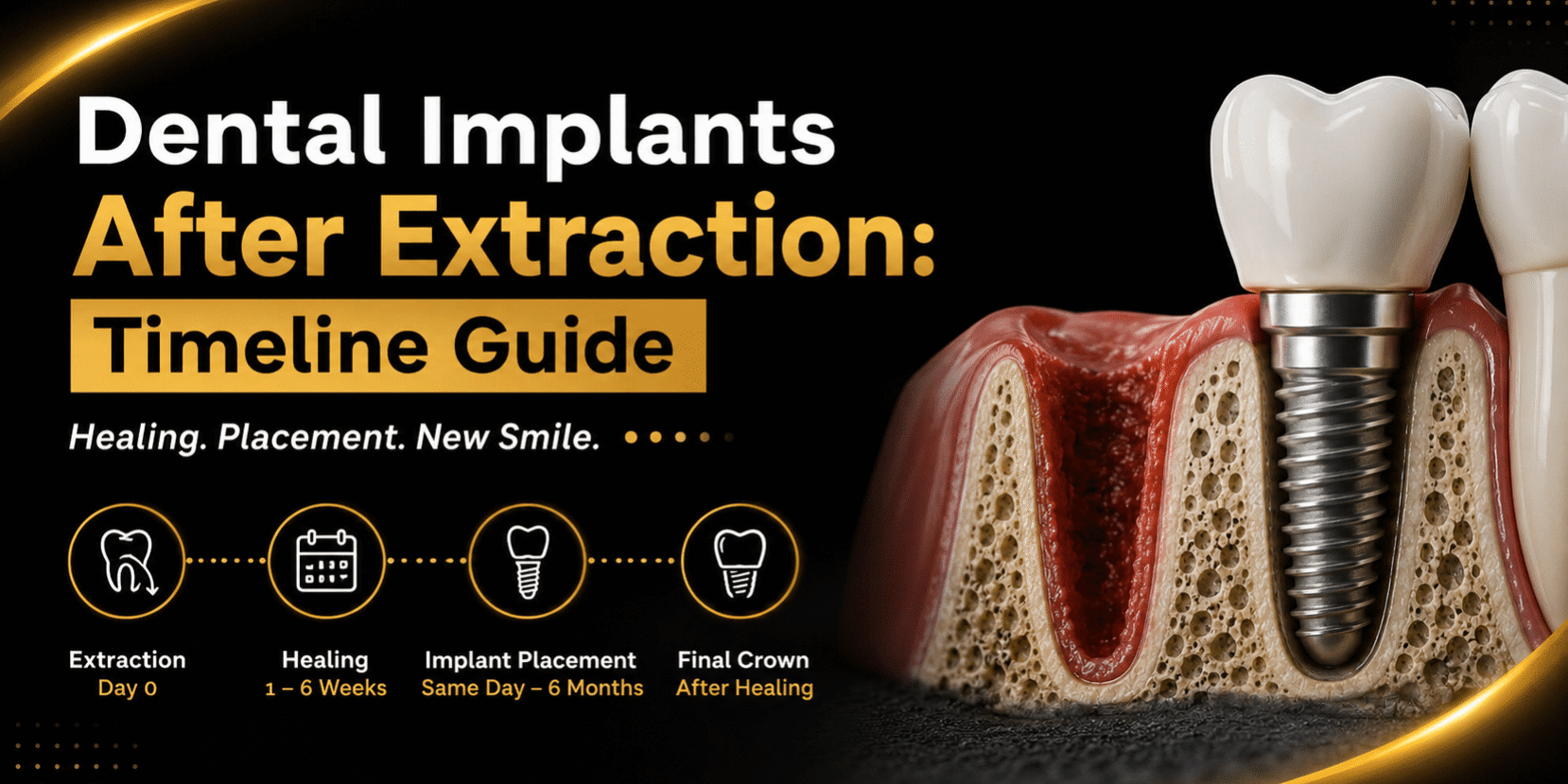
If you’ve just had a tooth pulled or you’re facing an extraction soon, you’re probably wondering how fast you can get a dental implant in that spot. The honest answer: it depends on your bone health, gum tissue, and how the extraction site heals, but most patients fall into one of three timelines immediate placement, early placement after a few weeks, or delayed placement after three to six months. This guide walks through each path, what happens at every stage, and how your dentist decides which timeline fits your mouth.
Why Timing Matters After a Tooth Is Removed
Once a tooth comes out, the body starts remodeling the socket almost immediately. Blood clots form within hours, and over the following weeks, that clot converts into soft tissue, then into new bone. This process is called socket healing, and it directly affects whether an implant can go in right away or needs to wait.
Bone volume tends to shrink the most during the first three to six months after extraction. That’s why dentists don’t take a “wait and see” approach lightly, waiting too long without a bone graft can actually make dental implants after extraction more complicated, not less. On the other hand, placing an implant too early into an infected or unstable socket risks failure. The goal is finding the window where healing has progressed enough for stability, but not so much that bone has been lost.
The Three Main Implant Timelines
Dentists generally classify implant placement into three categories based on timing relative to the extraction. Each has its own advantages, risks, and ideal candidates.
| Timeline Type | When Placed | Best For |
| Immediate Placement | Same day as extraction | Healthy bone, no active infection, good gum tissue |
| Early Placement | 6 to 12 weeks after extraction | Sites needing partial soft tissue healing first |
| Delayed Placement | 3 to 6 months after extraction | Sites with infection, thin bone, or requiring grafting |
Immediate Placement: Same-Day Implants
Immediate dental implants involve placing the implant fixture into the socket right after the tooth is removed, during the same appointment. This approach appeals to a lot of patients because it cuts down on the number of surgical visits and can shorten the overall treatment timeline by months.
Not everyone qualifies, though. For dental implants same day as extraction to work well, the socket walls need to be intact, there shouldn’t be active infection or significant bone loss around the roots, and the surrounding gum tissue needs to be healthy enough to support primary closure or a graft material if needed. Front teeth with thin, delicate bone are sometimes trickier candidates than back molars, simply because the aesthetic stakes are higher and the bone anatomy is less forgiving.
When immediate placement is successful, the implant achieves what’s called primary stability meaning it’s mechanically locked into the bone even before biological healing (osseointegration) begins. A temporary crown may sometimes be attached the same day for cosmetic purposes, though it’s usually kept out of full biting function until the implant has fused with the bone.
Early Placement: A Middle-Ground Approach
Early placement sits between immediate and delayed timelines. The dentist waits roughly six to twelve weeks, allowing the gum tissue and initial bone fill to mature without letting the socket collapse entirely. This is often chosen when there’s mild infection at the time of extraction that needs to resolve first, or when soft tissue needs a bit more time to close over the site properly.
This window still preserves much of the socket’s bone volume while reducing surgical risk compared to jumping straight to same-day placement.
Delayed Placement: Waiting for Full Healing
Delayed placement means waiting three to six months, sometimes longer, before placing the implant. This is the traditional and most predictable approach, especially for sites that had infection, significant bone loss, or required a bone graft to rebuild the socket.
During this healing period, the extraction site is often grafted with bone material to prevent the ridge from collapsing inward. By the time the implant goes in, the site has typically formed enough new, stable bone to support long-term implant success.
So, How Long Does the Entire Process Actually Take?
This is one of the most common questions patients ask, and it’s worth breaking down because “getting an implant” isn’t a single appointment it’s a series of stages.
How long does it take for a dental implant to be fully functional, from extraction to final crown, generally ranges from three months to about nine months. Immediate placement cases on the faster end might reach a finished crown around four to six months post-extraction, since the implant and healing happen somewhat in parallel. Delayed placement cases, especially those needing grafting, can stretch closer to eight or nine months once you factor in graft healing time plus implant osseointegration.
Osseointegration itself the biological process where bone cells grow directly onto the implant surface — typically takes three to six months regardless of when the implant was placed. This step can’t be rushed. It’s the foundation of implant stability, and loading the implant with a permanent crown too early is one of the more preventable causes of implant failure.
Typical Stage-by-Stage Timeline
| Stage | Approximate Duration | What Happens |
| Extraction & Initial Healing | 1 to 2 weeks | Socket clot forms, soft tissue begins closing |
| Bone Grafting (if needed) | 3 to 4 months | Graft material integrates with native bone |
| Implant Placement | Single appointment | Titanium fixture inserted into bone |
| Osseointegration | 3 to 6 months | Bone fuses to implant surface |
| Abutment & Crown Placement | 2 to 4 weeks | Final restoration attached |
Every mouth heals at its own pace, so these numbers are reasonable averages rather than guarantees. Smoking, uncontrolled diabetes, and certain medications can slow healing considerably, while younger patients with dense, healthy bone sometimes heal faster than average.
What Influences Which Timeline Is Right for You
A few factors consistently shape the decision between immediate, early, or delayed placement.
Bone density and volume at the extraction site matter most. A CT scan or 3D imaging usually confirms whether there’s enough bone to stabilize an implant right away or whether grafting is needed first. Active infection is another major factor placing an implant into an infected socket significantly raises the risk of early failure, so infected sites almost always require a delayed approach.
Gum tissue health plays a role too, particularly for front teeth where the visible gumline needs to look natural around the final crown. Overall health conditions, including smoking habits, diabetes control, and bone-affecting medications like bisphosphonates, can also push a dentist toward a more conservative, delayed timeline.
Patients typically go through a thorough evaluation, including imaging and a review of medical history, before a timeline recommendation is made. This step matters because the “fastest” option isn’t always the safest one for every individual case.
Signs Your Extraction Site Is Healing Well
Knowing what normal healing looks like helps you understand whether you’re on track for your planned implant timeline.
- Gum tissue gradually closes over the socket within two to four weeks
- Swelling and tenderness decrease noticeably after the first few days
- No persistent bad taste, odor, or discharge from the site
- Minimal to no bleeding after the initial 24 to 48 hours
- Bite feels increasingly comfortable without sharp or throbbing pain
- No visible bone fragments or exposed socket walls after the first week
If any of these signs seem off, it’s worth checking in with your dentist before assuming the site is ready for the next step, whether that’s a graft or implant placement.
Risks of Rushing or Delaying Too Long
There’s a balance to strike here. Placing an implant too soon into a socket that hasn’t stabilized can lead to poor primary stability, which raises failure risk. On the flip side, waiting far longer than necessary without any bone maintenance can allow the ridge to shrink to the point where grafting becomes mandatory even in cases that might not have needed it otherwise.
This is part of why dentists lean on imaging and clinical judgment rather than a one-size-fits-all rule. A socket that looks healed on the surface may still lack the internal bone density needed for a stable implant.
Regular follow-up visits during the waiting period help catch problems early, whether that’s a graft that isn’t integrating as expected or a socket that’s healing slower than average. These check-ins are usually brief, often just a visual exam and sometimes a repeat scan, but they give your dentist the information needed to confirm you’re still on track for the originally planned timeline. Skipping these appointments can mean a delayed diagnosis if something isn’t progressing normally, which in turn can push your overall treatment timeline back further than necessary.
How Implant Location Affects the Timeline
Where the missing tooth sits in your mouth also shapes the approach. Molars carry heavier chewing forces and tend to have wider sockets with more surrounding bone, which sometimes makes them more forgiving candidates for immediate placement. Front teeth, on the other hand, sit in thinner bone and are far more visible when you smile or speak, so dentists are often more conservative here, favoring early or delayed placement paired with careful attention to gum contour.
Upper jaw sites near the sinus cavity introduce another variable. If the sinus floor sits close to the extraction site, there may not be enough vertical bone height for immediate placement, and a sinus lift procedure might be needed before an implant can go in safely. Lower jaw sites don’t carry this particular concern, though nerve position still needs to be mapped carefully through imaging beforehand.
Caring for Your Mouth Between Extraction and Implant
Whatever timeline you’re on, the weeks between extraction and implant placement matter for long-term success. Keeping the site clean without disturbing the healing clot, avoiding smoking, and eating softer foods for the first week or two all support steady healing. Rinsing gently with warm salt water after the first 24 hours can help keep the area clean without disrupting tissue formation.
Patients who are grafting before implant placement should follow their dentist’s specific aftercare instructions closely, since graft material needs a stable, undisturbed environment to integrate properly with existing bone.
When to Talk to Your Dentist About Your Timeline
If you’re still deciding between immediate and delayed placement, the best next step is a consultation that includes imaging of the extraction site. Every mouth presents differently, and a timeline that worked well for a friend or family member may not be the right fit for your bone structure or health history. A dentist can walk through your specific situation and lay out realistic expectations before any procedure begins.
Frequently Asked Questions
Can I get a dental implant the same day as my extraction?
In many cases, yes, if the socket has healthy bone, no active infection, and stable surrounding tissue. Your dentist will confirm eligibility through an exam and imaging before recommending same-day placement.
How painful is the healing process after extraction and implant placement?
Most patients describe manageable discomfort similar to a routine extraction, typically controlled with over-the-counter or prescribed pain relief for a few days. Pain that worsens after the first few days should be evaluated.
Do I need a bone graft before getting an implant?
Not always. Grafting is usually recommended when there’s significant bone loss, infection at the extraction site, or thin ridge width that wouldn’t otherwise support a stable implant.
What happens if I wait too long after extraction to get an implant?
Extended delays without bone maintenance can lead to ridge shrinkage, which may require grafting later even if it wasn’t initially necessary.
Is immediate implant placement as successful as delayed placement?
Success rates for immediate placement can be comparable to delayed placement when patients are properly selected, though case selection is more restrictive for immediate cases.
How many appointments does the full implant process usually take?
It typically involves an initial consultation, the extraction and/or implant placement visit, a healing period with occasional check-ins, and a final visit for the abutment and crown.
Will I have a gap in my smile while the implant heals?
Depending on the location and your preference, a temporary restoration such as a removable partial or temporary crown can often fill the gap during healing.