Losing a tooth does not mean you have to live with a visible gap or difficulty chewing. The two common fixed options are dental implants vs bridges, but they solve tooth loss in different ways. A dental bridge replaces a missing tooth by using neighboring teeth for support, while an implant replaces the tooth root and supports a crown. Implants generally preserve more of the surrounding bone and do not require neighboring teeth to be prepared, while bridges can offer a faster and less involved treatment in appropriate cases. This guide compares their benefits, disadvantages, maintenance, longevity, appearance, and other factors that can help you discuss the right choice with your dentist.
What Is the Difference Between a Dental Implant and a Bridge?
The fundamental difference is how each restoration is supported.
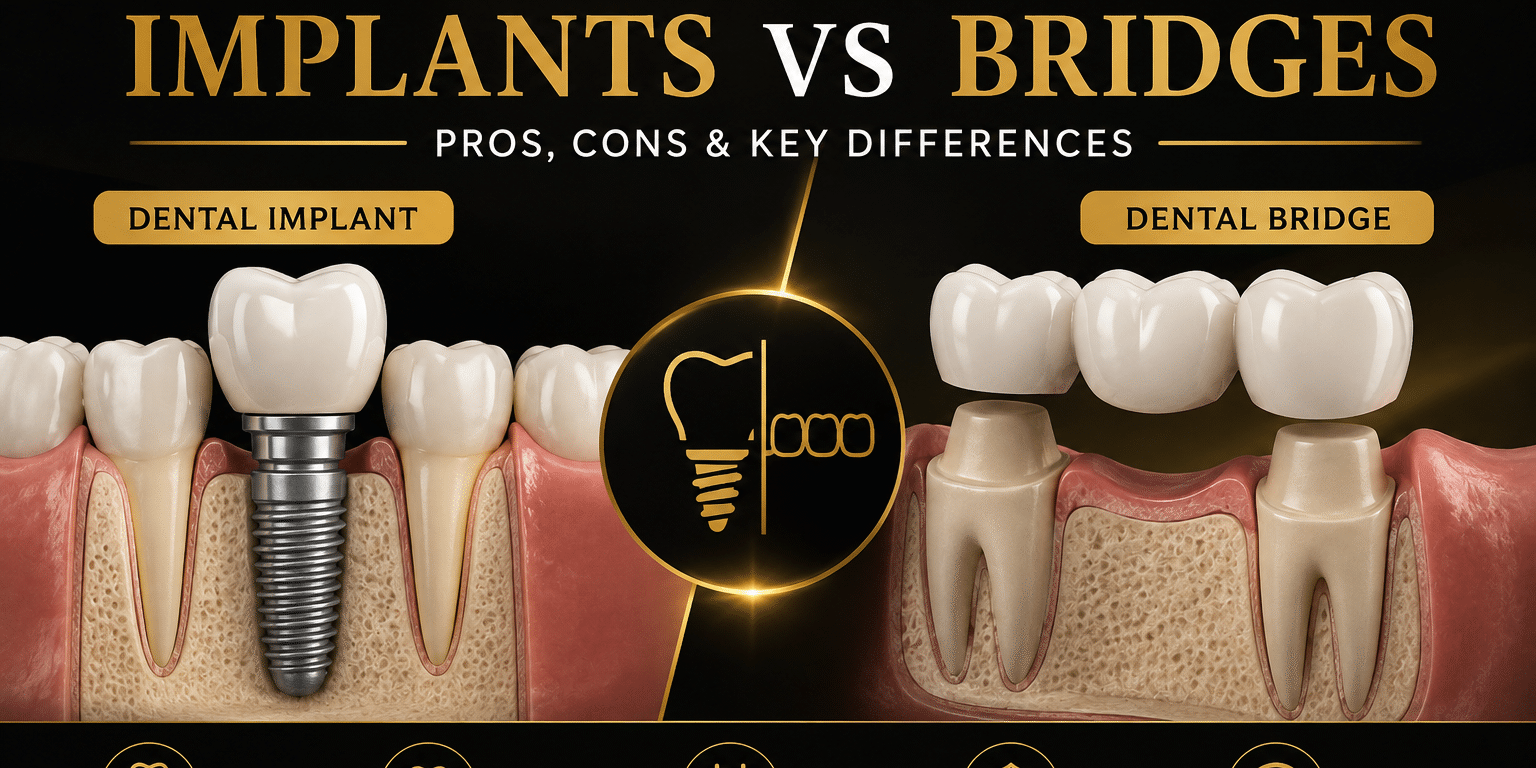
A dental implant is a small titanium or other biocompatible implant placed into the jawbone to act as an artificial tooth root. After the implant integrates with the bone, an abutment and dental crown are attached to replace the visible portion of the missing tooth.
A dental bridge does not replace the missing root. Instead, it uses crowns placed over one or more neighboring teeth to support an artificial tooth, known as a pontic. The result is a fixed restoration that fills the gap without being removable by the patient.
Both can restore chewing function and improve the appearance of a smile. The better choice depends on factors such as the condition of the surrounding teeth, available bone, gum health, overall oral health, treatment preferences, and long-term goals.
Dental Implants vs Bridges: Quick Comparison
| Feature | Dental Implant | Dental Bridge |
| Tooth root replaced | Yes | No |
| Support | Jawbone | Neighboring teeth or implants |
| Neighboring teeth altered | Usually no | Usually yes for traditional bridges |
| Bone preservation | Helps maintain bone around the implant site | Does not replace the missing root |
| Treatment process | Usually takes several stages | Often completed in fewer stages |
| Removable by patient | No, when properly restored | No, when permanently cemented |
| Maintenance | Brushing, flossing, and implant-specific cleaning | Brushing and cleaning beneath the bridge |
| Longevity | Can be long-lasting with proper care | Can also provide many years of service |
| Suitable for everyone | No | No |
| Root canal or crown needed on adjacent teeth | Not necessarily | May be required as part of preparation |
The choice should be based on an examination rather than simply selecting the option that sounds more advanced. A dentist needs to evaluate the teeth, gums, bite, jawbone, and overall oral condition before recommending a restoration.
Dental Implants: How They Work
An implant restoration is designed to replace both the function of a missing tooth and, to a degree, the role of its root.
The implant is placed into the jawbone. Over time, the surrounding bone can integrate with the implant through a process called osseointegration. Once healing and integration are sufficient, the implant can support an abutment and crown.
This approach creates a restoration that is supported independently of the neighboring natural teeth.
Advantages of Dental Implants
One of the biggest advantages of an implant is that it does not normally require reducing healthy neighboring teeth to support the restoration.
That matters because traditional dental bridges typically depend on adjacent teeth. With an implant, the restoration can stand independently in the location of the missing tooth.
Implants also provide stimulation to the surrounding jawbone. Natural tooth roots transmit forces to the bone, and when a tooth is lost, the bone in that area can gradually shrink. An implant can provide functional stimulation that helps maintain bone around the implant site.
Other potential advantages include:
- A natural-looking appearance when properly planned and restored
- Stable support during chewing
- No need to use neighboring healthy teeth as bridge abutments
- Easy integration into a normal oral hygiene routine
- Potential for long-term service with appropriate care
An implant-supported crown can also be designed to closely match the color, shape, and proportions of the surrounding teeth.
Disadvantages of Dental Implants
Dental implants are not the simplest tooth replacement option. Treatment usually requires surgery and a healing period, so the process can take longer than a conventional bridge.
Adequate bone volume and healthy gum tissue are also important considerations. If substantial bone has been lost, a dentist may recommend a bone graft or another procedure before implant placement. Not every patient needs grafting, but it may be necessary in certain cases.
Implant treatment also requires careful planning. Factors such as smoking, uncontrolled systemic conditions, poor oral hygiene, active gum disease, and certain medications can affect treatment suitability or healing.
Another consideration is that implants involve more stages than many traditional bridges. The process may include examination and imaging, implant placement, healing, abutment placement, and final crown placement.
An implant is therefore not automatically the best choice for every patient.
Dental Bridges: How They Work
A traditional dental bridge replaces a missing tooth with an artificial tooth attached to crowns that fit over neighboring teeth.
For example, if one tooth is missing between two healthy teeth, those teeth may serve as supports for the bridge. The supporting teeth are prepared so the bridge can fit securely over them.
Other bridge designs exist as well. Depending on the location and clinical circumstances, dentists may consider cantilever bridges, Maryland bridges, or implant-supported bridges.
Advantages of Dental Bridges
One major advantage of a traditional bridge is that treatment can often be completed more quickly than an implant restoration.
A bridge may be a practical option when a patient wants a fixed replacement without undergoing implant surgery. It can also be useful when the neighboring teeth already require crowns because of significant damage or existing restorations.
A bridge can restore the appearance of the smile and help distribute chewing forces across the restoration and its supporting teeth.
For some patients, bridges can also be a sensible choice when implant placement is not appropriate because of bone limitations, medical considerations, or personal preferences.
Disadvantages of Dental Bridges
The main limitation of a traditional bridge is its dependence on neighboring teeth.
Healthy adjacent teeth generally need to be prepared to accommodate the crowns that support the bridge. This means removing some natural tooth structure. Once a tooth has been prepared for a traditional bridge, it cannot simply be returned to its original condition.
A bridge also does not replace the missing tooth root. As a result, the bone beneath the missing tooth can continue to change over time.
Cleaning can require extra attention as well. Food particles and plaque can collect beneath the artificial tooth, so patients need to clean around and under the bridge carefully.
If one of the supporting teeth develops decay, gum disease, or another problem, the stability of the bridge may be affected.
Single Implants vs Dental Bridges: Advantages and Disadvantages
For someone missing one tooth, the comparison becomes particularly relevant because an individual implant can replace the missing tooth without involving the neighboring teeth.
| Consideration | Single Implant | Dental Bridge |
| Effect on adjacent teeth | Usually preserves them | Requires preparation for a traditional bridge |
| Jawbone | Helps preserve bone around the implant | Does not replace the root |
| Surgery | Requires implant placement | Usually does not require implant surgery |
| Treatment time | Often longer | Often shorter |
| Cleaning | Requires careful brushing and flossing around implant | Requires cleaning under and around bridge |
| Independence | Supported independently | Relies on adjacent teeth |
| Initial treatment complexity | More involved | Generally simpler |
| Long-term maintenance | Requires professional monitoring | Requires monitoring of bridge and supporting teeth |
Neither option should be selected based on one factor alone. A young adult with healthy adjacent teeth may have different priorities from someone whose neighboring teeth already need extensive restorations.
How Do You Maintain a Dental Implant?
An implant still needs daily care even though the replacement tooth cannot develop a cavity in the same way natural enamel can.
Plaque can accumulate around an implant, and inflammation of the surrounding tissues can become a serious concern. Good oral hygiene helps protect the gum and bone around the implant.
A typical maintenance routine includes:
- Brushing twice daily with a soft-bristled toothbrush
- Cleaning between teeth and around the implant
- Following any personalized cleaning recommendations from your dentist
- Attending regular dental examinations and professional cleanings
- Addressing bleeding, swelling, discomfort, or changes around the implant promptly
Your dentist or dental hygienist can demonstrate the most suitable technique and cleaning aids for your restoration.
How Do You Maintain a Dental Bridge?
Bridge maintenance focuses on protecting both the restoration and the natural teeth underneath or around it.
Brushing alone may not effectively clean every surface. The area underneath the artificial tooth is especially important because plaque and food debris can accumulate there.
Floss threaders, interdental brushes, water flossers, or other cleaning aids may be recommended depending on the bridge design and your individual needs.
Regular dental visits allow the supporting teeth and surrounding gums to be monitored. A problem with an abutment tooth can sometimes affect the entire bridge, making prevention particularly valuable.
When Is a Dental Implant Usually Considered?
A dental implant may be considered when a patient has sufficient bone and healthy oral tissues to support implant treatment.
It can be particularly attractive when the adjacent teeth are healthy and do not need crowns. Instead of cutting down those teeth to support a bridge, an implant can replace the missing tooth independently.
However, implant treatment may require additional planning if there has been significant bone loss or if gum disease is present.
Can an Implant Support a Dental Bridge?
Yes. A dental implants bridge is another type of tooth replacement.
Instead of using natural teeth as supports, two or more dental implants can support a bridge when several adjacent teeth are missing. This can provide a fixed alternative to a removable partial denture in appropriately selected cases.
Implant-supported bridges can be especially useful when replacing multiple missing teeth. The exact number and position of implants depend on the patient’s anatomy, bite, bone availability, and treatment plan.
This is different from placing one implant for every missing tooth. In some situations, strategically positioned implants can support a multi-tooth restoration.
What Factors Should You Discuss With Your Dentist?
Choosing between implants and bridges should involve more than comparing pictures or reading about advantages online.
Your dentist will consider the condition of the missing-tooth area and the rest of your mouth. Bone levels, gum health, neighboring teeth, bite, oral hygiene, general health, previous dental treatment, and your preferences can all influence the recommendation.
It is also useful to ask about the complete treatment sequence. Understanding healing requirements, temporary restorations, expected maintenance, and potential future repairs can help you make an informed decision.
A treatment that looks ideal on paper may not be suitable for a particular mouth. Personalized evaluation is therefore essential.
Frequently Asked Questions
Are dental implants better than bridges?
Neither option is universally better. Implants can preserve adjacent teeth and provide independent support, while bridges can offer a faster and less surgical approach. The right option depends on your oral health, bone, neighboring teeth, preferences, and treatment goals.
Is a bridge or implant better for one missing tooth?
For a single missing tooth, an implant can replace the tooth independently without preparing healthy neighboring teeth. A bridge may still be appropriate when adjacent teeth need crowns or when implant treatment is not suitable.
Is a dental implant more comfortable than a bridge?
Both can become comfortable once the mouth adapts to the restoration. An implant is anchored in the jawbone, while a traditional bridge is supported by neighboring teeth. Comfort depends on proper fit, bite, healing, and individual circumstances.
Do dental implants prevent bone loss?
An implant can help maintain bone around the implant site by providing functional stimulation to the jawbone. However, it does not necessarily prevent bone changes everywhere in the jaw.
Can a dental bridge look natural?
Yes. A well-designed bridge can closely match the color, shape, and proportions of neighboring teeth. The final appearance depends on factors including restoration design, tooth position, gum health, and dental laboratory work.
How do I compare dental bridge vs implant cost?
Compare the complete treatment plan rather than only the initial restoration price. An implant may involve multiple stages and components, while a bridge involves preparation and restoration of supporting teeth. Your dentist can provide an individualized cost estimate.
Can you have a bridge supported by dental implants?
Yes. Implant-supported bridges can replace several adjacent missing teeth using strategically positioned implants for support. This approach differs from a traditional bridge, which relies on natural neighboring teeth.
Final Thoughts
The decision between dental implants vs bridges comes down to more than appearance or treatment time. Implants replace the missing root and can provide independent support while helping maintain bone around the implant site. Bridges can restore a missing tooth without implant surgery and may be particularly practical when neighboring teeth already require significant restoration.
For a single missing tooth, an implant may be appealing when the surrounding teeth are healthy and the patient is a suitable candidate. A bridge may be a sensible alternative when neighboring teeth need crowns, implant treatment is not appropriate, or a shorter treatment process is preferred.
A dental examination is the best way to determine which option fits your mouth. Your dentist can evaluate your teeth, gums, bone, bite, and long-term goals and explain the benefits and limitations of each treatment before you make a decision.