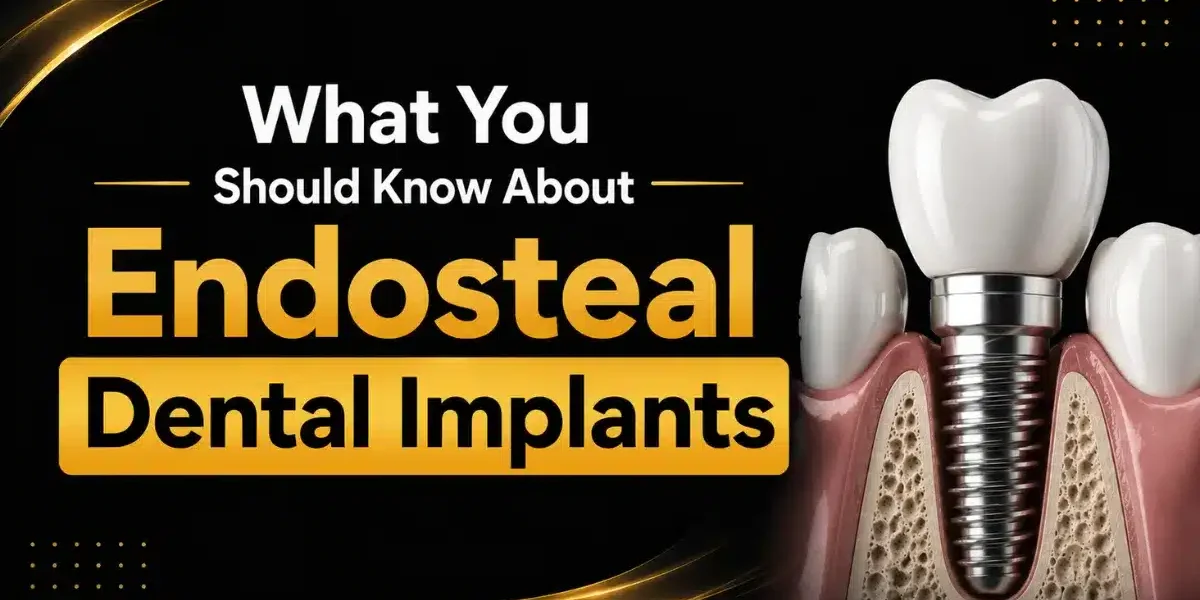
Endosteal dental implants are the most common solution for replacing missing teeth because they are placed directly into the jawbone, where they become securely fused through the natural osseointegration of dental implants process. Most modern implants are made from medical-grade titanium, allowing them to function much like natural tooth roots while preserving jawbone health and restoring normal chewing ability.
If you’re researching dental implant types, understanding how endosteal implants work can help you determine whether they are the right choice for your smile. This guide explains the complete procedure, benefits, healing process, risks, and long-term care so you know exactly what to expect before starting treatment.
What Are Endosteal Dental Implants?
Endosteal dental implants are small titanium posts surgically placed inside the jawbone to replace missing tooth roots. Unlike dentures that rest on the gums or bridges that rely on neighboring teeth for support, these implants become a permanent part of the jaw through natural bone healing.
Once the implant has fully integrated with the surrounding bone, it supports a custom-made dental crown, bridge, or implant-supported denture. Because the implant functions like a natural tooth root, it restores both appearance and function while helping preserve bone that would otherwise shrink after tooth loss.
Today, endosteal implants are considered the gold standard in implant dentistry because they provide excellent stability, long-term durability, and one of the highest success rates among all tooth replacement options.
Whether you’re missing one tooth or several, this treatment can often provide a solution that feels remarkably similar to natural teeth.
Why Are Endosteal Dental Implants the Most Common Choice?
Among all available dental implant types, endosteal implants are used in the majority of implant procedures worldwide.
Their popularity isn’t simply because they’ve been around the longest. They consistently produce reliable results for properly selected patients.
Unlike removable dentures that may shift while eating or speaking, endosteal implants remain securely anchored inside the jawbone. This stability allows patients to enjoy foods they may have avoided for years while also improving speech and overall comfort.
Another significant advantage is bone preservation. After a tooth is lost, the jawbone no longer receives stimulation from chewing, causing gradual bone resorption. Endosteal implants restore that stimulation, helping maintain facial structure and reducing future bone loss.
Many patients also appreciate that implant-supported restorations closely resemble natural teeth. Once the crown is attached, most people cannot distinguish the implant from surrounding teeth.
For these reasons, dentists often recommend endosteal implants as the first treatment option whenever sufficient bone is available.
Understanding Different Dental Implant Types
Patients often assume every implant is identical, but implant dentistry includes several treatment options depending on bone availability, oral health, and individual needs.
| Implant Type | Placement | Best For |
| Endosteal Implant | Inside the jawbone | Most patients with adequate bone |
| Subperiosteal Implant | On top of the jawbone beneath the gums | Patients with severe bone loss |
| Zygomatic Implant | Anchored into the cheekbone | Advanced upper jaw bone deficiency |
Although all three options can successfully replace missing teeth, endosteal implants remain the preferred choice because they closely replicate the natural tooth root while offering excellent long-term stability.
If you’re still comparing implant options, our guide on different types of dental implants explains how each option differs and when each one may be recommended.
Why Titanium Is Used for Dental Implants
One of the biggest reasons for the success of dental implants titanium is the material itself.
Titanium has been used safely in medicine for decades because it combines exceptional strength with outstanding compatibility with the human body.
Unlike many metals, titanium naturally forms a protective oxide layer that resists corrosion and allows bone cells to attach directly to its surface. This unique biological compatibility makes it ideal for implant dentistry.
Titanium also offers several practical benefits.
- It is lightweight but extremely strong.
- It resists corrosion from saliva and body fluids.
- It can withstand years of chewing pressure.
- It integrates naturally with the surrounding bone.
- It has decades of documented clinical success.
Because of these advantages, titanium remains the material of choice for most implant systems used worldwide.
Although zirconia implants have become more popular in recent years, titanium continues to have the strongest long-term scientific evidence supporting its performance.
What Is Osseointegration of Dental Implants?
One of the most important concepts patients should understand before implant treatment is the osseointegration of dental implants.
Osseointegration is the biological process where living bone grows directly onto the titanium implant surface. Instead of simply holding the implant in place mechanically, the jawbone actually bonds with it over time.
This process transforms the implant into a stable artificial tooth root capable of handling everyday chewing forces.
Healing begins immediately after implant placement.
During the first few weeks, the body forms new bones around the implant. Over the following months, this bone becomes denser and stronger until the implant is firmly integrated into the jaw.
Without successful osseointegration, implant treatment cannot succeed.
Several factors influence how well this healing occurs, including:
- Bone quality and density.
- Overall oral health.
- Smoking habits.
- Medical conditions affecting healing.
- Proper implant placement.
- Good oral hygiene during recovery.
Fortunately, modern imaging technology and careful treatment planning allow dentists to maximize the chances of successful integration before surgery even begins.
Who Is a Good Candidate for Endosteal Dental Implants?
Not every patient automatically qualifies for implant treatment, but many people are excellent candidates.
Generally, dentists look for healthy gums, adequate jawbone volume, and good overall health before recommending endosteal implants.
Ideal candidates typically include adults who have lost one or more teeth due to decay, injury, or periodontal disease and want a permanent replacement rather than removable dentures.
Patients should also be committed to maintaining excellent oral hygiene after treatment because healthy gums play a major role in long-term implant success.
Certain medical conditions don’t automatically prevent implant placement, but they may require additional planning.
These include uncontrolled diabetes, heavy smoking, immune disorders, previous radiation therapy, or medications that affect bone healing.
Rather than relying solely on traditional X-rays, most implant evaluations now include three-dimensional CBCT imaging. These scans allow the dentist to measure bone volume, locate nerves, evaluate sinus anatomy, and determine the safest implant position before surgery.
This advanced planning significantly improves accuracy while reducing potential complications.
The Complete Endosteal Dental Implant Procedure
One reason patients feel anxious about implant treatment is that they don’t fully understand what happens during the procedure.
In reality, the process is carefully planned and completed in several stages to ensure long-term success.
Step 1: Comprehensive Consultation
Every implant journey begins with a complete examination.
The dentist reviews your medical history, examines your gums, evaluates remaining teeth, and obtains digital X-rays or CBCT scans.
This information determines whether enough bone exists to support the implant or if additional procedures, such as bone grafting or sinus augmentation, may be recommended.
Patients often ask questions about recovery, discomfort, and treatment timing during this appointment.
If you’re wondering about recovery after surgery, our guide on Are dental implants painful? explains what most patients experience before, during, and after implant placement.
Step 2: Treatment Planning
Every patient’s mouth is different.
The exact implant size, length, angle, and location are digitally planned before surgery.
Modern guided implant technology allows dentists to place implants with remarkable precision, improving safety while protecting nearby nerves and surrounding structures.
Instead of relying solely on experience during surgery, digital planning creates a personalized roadmap for implant placement.
Step 3: Dental Implant Placement
The implant placement procedure itself is usually shorter than many patients expect.
After the area is completely numbed with local anesthesia, the dentist makes a small opening in the gum tissue to access the jawbone.
Using specialized instruments, a precisely sized channel is prepared within the bone before the titanium implant is gently inserted.
Once the implant is in position, the surrounding tissue is carefully closed to allow healing.
For many single-tooth implants, the surgical appointment takes approximately one hour, although more complex cases involving multiple implants may require additional time.
Most patients describe feeling pressure rather than pain during the procedure because the treatment area remains numb throughout surgery.
Step 4: Healing and Osseointegration
After surgery, the real success of the implant begins beneath the surface. During the next several weeks, the jawbone gradually fuses with the titanium implant through the natural osseointegration of dental implants process. This biological connection transforms the implant from a small titanium post into a stable artificial tooth root capable of supporting everyday chewing forces.
Healing doesn’t happen overnight. Your body continuously produces new bone cells around the implant until the surrounding bone becomes dense enough to hold it securely. Depending on bone quality, age, general health, and whether additional procedures such as bone grafting were required, this stage typically takes between three and six months.
Although patients often want immediate results, allowing adequate healing time significantly improves long-term success. Rushing to place the final crown before complete osseointegration can increase the risk of implant movement or failure.
If you’re wondering how long each stage usually takes, our detailed guide on how long it takes to get dental implants explains the complete treatment timeline from consultation to final restoration.
Step 5: Placing the Abutment
Once the implant has successfully integrated with the jawbone, the next phase begins.
A small connector called an abutment is attached to the implant. This component acts as the connection between the implant itself and the final dental crown.
In many modern implant systems, the abutment can be placed during a brief appointment under local anesthesia. The surrounding gum tissue then heals around the abutment, creating a natural-looking emergence profile that closely resembles the appearance of a natural tooth.
Because every patient’s smile is unique, the size, angle, and design of the abutment are carefully selected to achieve both strength and aesthetics.
Step 6: Custom Crown Placement
The final stage is often the most exciting for patients because this is when the missing tooth is fully restored.
After the gums have healed, digital impressions or precise molds are taken to fabricate a custom dental crown.
The laboratory designs the crown to match the color, shape, size, and contours of your surrounding teeth.
Once completed, the crown is securely attached to the abutment.
The finished restoration is designed to:
- Restore normal chewing ability.
- Blend naturally with neighboring teeth.
- Support clear speech.
- Maintain facial appearance.
- Provide long-term durability.
With proper care, many implant crowns remain functional for well over a decade, while the implant itself can last much longer.
Benefits of Endosteal Dental Implants
Endosteal implants offer advantages that extend far beyond replacing a missing tooth.
Instead of simply filling an empty space, they restore normal oral function while protecting surrounding structures.
| Benefit | How It Helps |
| Natural appearance | Closely resembles a real tooth |
| Excellent stability | Doesn’t slip during eating or speaking |
| Bone preservation | Reduces jawbone shrinkage after tooth loss |
| Long-term durability | Can last decades with proper care |
| Protects neighboring teeth | No need to reshape adjacent healthy teeth |
| Improved chewing | Allows a wider variety of foods |
| Better speech | Prevents movement associated with dentures |
| Increased confidence | Restores smile aesthetics |
One of the greatest advantages is that implants function independently.
Unlike traditional bridges that rely on adjacent teeth for support, endosteal implants preserve healthy teeth while replacing only the missing tooth.
Patients often report that after healing, they stop thinking about the implant entirely because it feels so natural during everyday activities.
Are There Any Risks?
Like every surgical procedure, implant placement carries certain risks. Fortunately, serious complications are uncommon when treatment is carefully planned and performed by an experienced implant dentist.
Potential complications may include:
- Temporary swelling or bruising.
- Minor bleeding after surgery.
- Infection around the implant.
- Delayed healing.
- Implant loosening if osseointegration does not occur.
- Rare nerve or sinus complications in specific anatomical situations.
The good news is that modern three-dimensional imaging has dramatically reduced many of these risks by allowing dentists to evaluate bone anatomy before surgery.
Following postoperative instructions, attending follow-up appointments, and maintaining excellent oral hygiene all contribute to successful healing.
Recovery After Endosteal Dental Implant Surgery
Recovery is usually easier than many patients expect.
Most people return to work and normal daily activities within one or two days after surgery.
Mild swelling, tenderness, and slight bruising are common during the first several days and typically improve quickly.
During early healing, dentists often recommend:
- Eating softer foods.
- Avoiding smoking.
- Keeping the surgical area clean.
- Taking prescribed medications as directed.
- Avoiding excessive chewing directly over the implant.
As healing progresses, normal eating habits gradually return.
Because every patient heals differently, recovery depends on factors such as general health, bone quality, smoking habits, and whether additional procedures were performed.
Long-Term Care for Endosteal Dental Implants
Receiving an implant is only the beginning.
Long-term success depends on consistent home care and regular professional maintenance.
Fortunately, caring for implants is very similar to caring for natural teeth.
Daily habits should include brushing twice each day using a soft toothbrush, cleaning between teeth with floss or interdental brushes, and attending routine dental examinations.
Patients sometimes believe implants cannot develop problems because they cannot decay like natural teeth.
While this is true, the surrounding gum tissue can still become inflamed if plaque is allowed to accumulate.
Healthy gums remain essential for protecting the bone supporting the implant.
Endosteal Implants Compared With Other Tooth Replacement Options
Many patients compare implants with bridges or removable dentures before making a decision.
The differences become clearer when viewed side by side.
| Feature | Endosteal Implant | Dental Bridge | Denture |
| Replaces tooth root | Yes | No | No |
| Prevents bone loss | Yes | No | No |
| Requires neighboring teeth | No | Yes | No |
| Removable | No | No | Yes |
| Chewing stability | Excellent | Very Good | Moderate |
| Long-term durability | Excellent | Good | Moderate |
Although each treatment has appropriate indications, endosteal implants often provide the closest replacement to a natural tooth.
What Can Affect Implant Success?
Several factors influence long-term outcomes.
Patients who maintain healthy habits generally experience excellent results for many years.
The most important success factors include:
- Good oral hygiene.
- Healthy gums.
- Adequate jawbone volume.
- Proper implant placement.
- Regular dental checkups.
- Avoiding smoking whenever possible.
Research consistently shows that patients who actively participate in maintaining their oral health enjoy the highest implant success rates.
Frequently Asked Questions
Are endosteal dental implants permanent?
The titanium implant itself is designed to be a long-term replacement for a missing tooth root. While the crown may eventually require replacement because of normal wear, the implant can often remain functional for decades with proper care.
Why are titanium implants used instead of other materials?
Medical-grade titanium is strong, lightweight, corrosion resistant, and highly biocompatible. Its unique ability to bond naturally with bone makes it the preferred material for modern implant dentistry.
How long does osseointegration take?
Most patients complete osseointegration within three to six months, although healing time varies depending on bone quality, overall health, and whether additional procedures such as bone grafting were required.
Are endosteal implants better than dentures?
For many patients, yes. Endosteal implants provide greater stability, improved chewing efficiency, better speech, and help preserve jawbone that dentures cannot protect.
Can older adults receive endosteal implants?
Age alone rarely prevents implant treatment. Many healthy older adults successfully receive implants after a comprehensive evaluation confirms adequate bone support and overall health.
Final Thoughts
Among all dental implant types, endosteal dental implants continue to be the most trusted solution for replacing missing teeth because they closely replicate the function of natural tooth roots. Their success depends on advanced planning, precise surgical placement, and the remarkable osseointegration of dental implants process that allows the jawbone to bond naturally with medical-grade titanium.
For patients with healthy gums and sufficient bone, endosteal implants offer outstanding stability, preserve jawbone health, improve chewing ability, and deliver results that can last for decades with proper care.
Every smile is unique, which is why a comprehensive examination is the first step toward determining whether endosteal implants are the right choice for your oral health. By understanding the complete procedure, recovery timeline, benefits, and long-term maintenance requirements, you can make an informed decision and move forward with confidence toward restoring both the appearance and function of your smile.