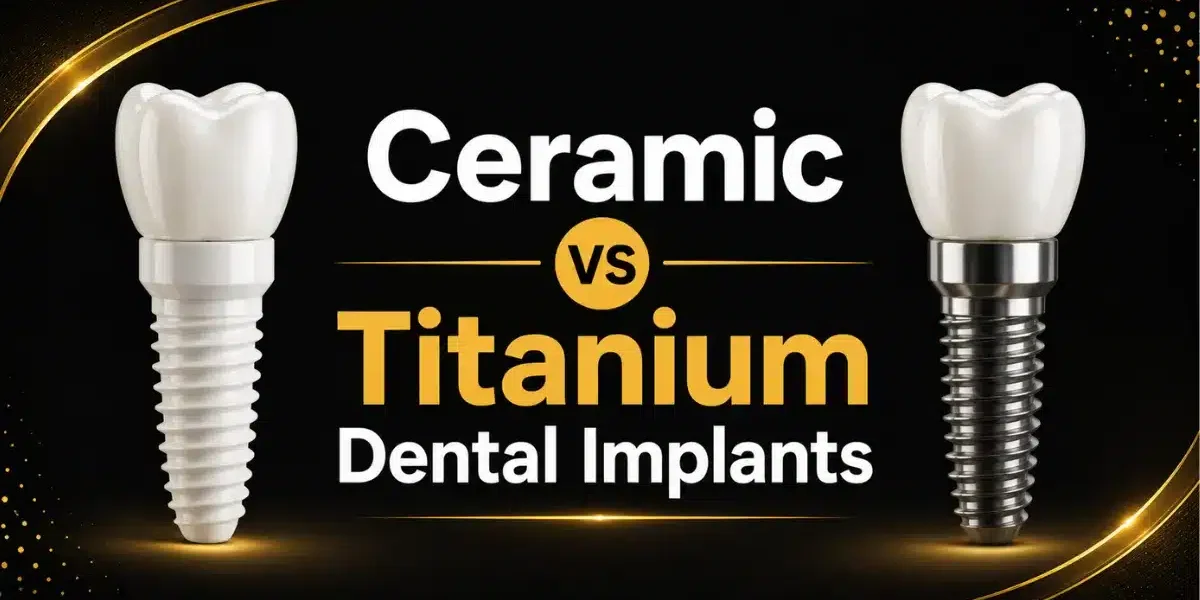
Ceramic dental implants and titanium implants are both designed to replace missing tooth roots, but they differ in material, appearance, strength, healing characteristics, and long-term clinical evidence. Ceramic dental implants, which are typically made from zirconia, are popular among patients seeking metal free dental implants, while titanium dental implants remain the most researched and widely used option due to their exceptional durability and decades of documented success. Choosing between dental implants zirconia vs titanium depends on factors such as bone quality, smile aesthetics, medical history, bite forces, and your dentist’s clinical recommendation.
Understanding how these implant systems differ will help you make a confident, informed decision based on your oral health rather than marketing claims alone.
What Are Ceramic Dental Implants?
Ceramic dental implants are implant fixtures manufactured primarily from zirconia, an advanced ceramic material known for its strength, biocompatibility, and natural white appearance.
Unlike traditional implants made from titanium, zirconia implants contain no metal, making them attractive for patients who prefer metal free dental implants or have concerns about visible gray metal beneath thin gum tissue.
Modern zirconia implants have improved considerably over the last decade. Earlier generations were more limited in design, but today’s ceramic implants are stronger, more precise, and supported by growing clinical research.
After placement inside the jawbone, ceramic implants heal through the same biological process as titanium implants. The surrounding bone gradually bonds to the implant surface, allowing it to function as an artificial tooth root capable of supporting a crown or bridge.
Although ceramic implants have become increasingly popular, they are still selected more carefully than titanium because not every clinical situation is suitable for zirconia.
What Are Titanium Dental Implants?
Titanium implants have been the gold standard in implant dentistry for more than forty years.
Made from medical-grade titanium or titanium alloys, these implants are surgically placed inside the jawbone, where they integrate through the natural process of osseointegration.
Their popularity comes from an outstanding combination of strength, longevity, flexibility, and predictable clinical outcomes.
Unlike removable tooth replacement options, titanium implants become permanently anchored within the jawbone, allowing patients to eat, smile, and speak confidently.
Today, millions of titanium implants are placed worldwide every year, making them the most extensively studied implant material available.
Patients who want a deeper understanding of implant materials and placement techniques can also explore our guide on Endosteal Dental Implants, which explains why titanium continues to be the preferred material for most implant procedures.
Ceramic Dental Implants vs Titanium: Understanding the Main Difference
Although both implant systems replace missing tooth roots, the biggest distinction is the material itself.
Titanium is a metal.
Ceramic implants are made from zirconia, a high-strength ceramic.
That difference influences several aspects of treatment, including appearance, flexibility, durability, and long-term research support.
Here’s a quick comparison.
| Feature | Ceramic Dental Implants | Titanium Dental Implants |
| Material | Zirconia ceramic | Medical-grade titanium |
| Metal-free | Yes | No |
| Color | White | Metallic gray |
| Clinical history | Growing research | More than 40 years |
| Flexibility | Lower | Higher |
| Long-term evidence | Good | Excellent |
| Common availability | Moderate | Widely available |
Both materials are highly biocompatible and capable of successful osseointegration.
The decision usually depends more on patient needs than on one material being universally “better.”
Appearance: Which Looks More Natural?
For many patients, appearance is one of the biggest deciding factors.
Ceramic implants are naturally white.
Because of this, they may provide an aesthetic advantage in patients with thin gums or areas where gum recession is more likely.
If the surrounding gum tissue is very delicate, a titanium implant can occasionally produce a faint gray shadow beneath the gums, particularly around upper front teeth.
Modern implant systems have greatly reduced this concern through improved implant designs and ceramic abutments, but it can still occur in certain cases.
Ceramic implants eliminate this possibility because the implant itself is tooth-colored.
For patients receiving implants in highly visible areas, especially the front of the smile, zirconia may offer a cosmetic advantage when conditions are appropriate.
However, appearance depends on far more than implant color alone.
The shape of the gums, crown design, surrounding bone, and overall treatment planning all contribute to creating a natural-looking smile.
How Strong Are Ceramic Dental Implants?
One of the most common misconceptions is that ceramic automatically means fragile.
That isn’t true.
Modern zirconia is an extremely durable material capable of withstanding significant chewing forces.
However, strength and fracture resistance are not exactly the same thing.
Titanium has a small amount of flexibility.
When heavy biting pressure occurs, titanium can absorb some of that force without fracturing.
Ceramic is much harder but also more rigid.
Because of this rigidity, ceramic implants require especially careful case selection and precise bite adjustment.
For patients with severe teeth grinding or extremely heavy bite forces, titanium often remains the preferred option because of its ability to tolerate repeated mechanical stress over many years.
This doesn’t mean ceramic implants are weak.
It simply means they perform best in carefully selected patients with favorable bite conditions.
Osseointegration: How Both Implants Heal
Regardless of the material, successful implant treatment depends on one biological process.
Osseointegration.
This is the natural healing process where living bone grows directly onto the implant surface.
Without successful osseointegration, neither titanium nor ceramic implants can function properly.
Fortunately, both materials demonstrate excellent compatibility with human bone.
Research shows that zirconia implants are capable of achieving strong bone attachment similar to titanium under appropriate conditions.
Several factors influence healing success regardless of the implant material.
- Bone density.
- Gum health.
- Overall health.
- Smoking habits.
- Surgical technique.
- Oral hygiene during healing.
Patients sometimes believe one material heals dramatically faster than the other.
Current evidence suggests that healing timelines are generally comparable when treatment is properly planned.
Who Chooses Metal Free Dental Implants?
Interest in metal free dental implants has increased significantly over the past several years.
Some patients simply prefer avoiding metal whenever possible.
Others appreciate the white appearance of zirconia.
Ceramic implants may be appropriate for patients who:
- Prefer metal-free restorations.
- Have thin gum tissue where aesthetics are especially important.
- Need replacement of front teeth.
- Have healthy bone volume.
- Are suitable candidates based on clinical evaluation.
Although true titanium allergy is extremely rare, patients with documented metal sensitivities sometimes ask about ceramic alternatives during their consultation.
Your dentist will evaluate whether zirconia is an appropriate choice based on your bite, jawbone, and long-term treatment goals.
Are Titanium Implants Safe?
Titanium has one of the longest safety records of any material used in modern dentistry.
Its success isn’t based on marketing.
It’s based on decades of clinical evidence involving millions of patients worldwide.
Medical-grade titanium naturally forms a stable oxide layer that protects it from corrosion while allowing bone cells to attach to its surface.
This exceptional biocompatibility is one reason titanium is also widely used in orthopedic surgery, joint replacements, and many other medical procedures.
Patients interested in understanding the overall safety profile of implants can also read our guide on Are Dental Implants Safe?, which explains both the benefits and potential risks associated with implant treatment.
Which Implant Lasts Longer?
Longevity is one of the biggest questions patients ask during implant consultations.
Titanium currently has the strongest long-term evidence because researchers have followed patients for several decades.
Many titanium implants remain fully functional after twenty, thirty, or even forty years when properly maintained.
Ceramic implants also demonstrate excellent success rates, but because they are newer, researchers simply have fewer decades of long-term data available.
That doesn’t mean ceramic implants fail sooner.
It means titanium currently has more extensive scientific evidence supporting lifetime performance.
For most patients, both implant materials can provide many years of reliable function when placed correctly and maintained with excellent oral hygiene.
Ceramic vs Titanium Dental Implants Comparison
Which Material Lasts Longer?
One of the biggest questions patients ask is whether ceramic dental implants last as long as titanium implants. The answer depends on several factors, including oral hygiene, bone quality, overall health, and the dentist’s expertise.
Titanium has the longest documented clinical history. Studies have followed dental implants titanium for more than 40 years, showing survival rates above 95% in many cases. Because of this extensive evidence, titanium remains the benchmark for implant dentistry.
Ceramic implants, particularly modern zirconia systems, have also demonstrated impressive success rates. Advances in manufacturing have significantly improved their strength and durability compared to earlier generations. While long-term research is still expanding, current clinical evidence suggests that zirconia implants can provide excellent outcomes when used in appropriately selected patients.
| Feature | Ceramic Dental Implants | Titanium Dental Implants |
| Clinical History | 15 to 20+ years | 40+ years |
| Long-Term Research | Growing | Extensive |
| Corrosion Resistance | Excellent | Excellent |
| Fracture Resistance | High but lower than titanium | Extremely high |
| Longevity | Excellent with proper care | Excellent with proper care |
For most healthy adults, both materials can last for decades when maintained correctly.
How Bone Integrates with Each Implant
Successful implants depend on osseointegration, the biological process where bone fuses directly with the implant surface.
Titanium naturally forms a protective oxide layer that encourages bone cells to attach securely. This property has made it the gold standard for decades.
Modern zirconia implants are manufactured with specially treated surfaces that also promote excellent bone attachment. Research shows that ceramic implants can achieve strong osseointegration comparable to titanium in many clinical situations.
Because of these advancements, the conversation has shifted from “Can ceramic integrate?” to “Which implant is better suited for this specific patient?”
Which Implant Looks More Natural?
Appearance is often a deciding factor, particularly when replacing front teeth.
Ceramic implants offer a clear cosmetic advantage because they are naturally white. If the gums are thin or recede slightly over time, the implant remains much less noticeable.
Titanium implants themselves are not usually visible because they sit beneath the gums. However, patients with very thin gum tissue may occasionally notice a gray shadow near the gumline.
This is why many cosmetic dentists recommend ceramic implants for highly visible areas of the mouth.
Patients considering smile enhancement often explore how to get perfectly white teeth before or after implant treatment to create a brighter, more balanced appearance.
Are Ceramic Implants Better for Gum Health?
Healthy gums play a critical role in implant success.
Studies suggest that zirconia surfaces accumulate less bacterial plaque than titanium. Lower plaque accumulation may reduce inflammation around the implant, making ceramic implants attractive for patients with a history of gum disease or those focused on long-term periodontal health.
However, gum health ultimately depends more on daily brushing, flossing, and regular dental cleanings than on implant material alone.
Whether you choose ceramic or titanium, maintaining excellent oral hygiene is the most effective way to protect your investment.
Strength Comparison Between Ceramic and Titanium
Strength is another important consideration.
Titanium is extremely flexible and resistant to fracture. It can tolerate high chewing forces, making it ideal for replacing molars and supporting full-mouth restorations.
Ceramic implants are also strong, but zirconia is inherently more rigid. Although modern zirconia is much tougher than older ceramics, excessive force may increase fracture risk in specific situations.
Dentists evaluate several factors before recommending ceramic implants, including:
- Bite force
- Teeth grinding (bruxism)
- Implant location
- Bone density
- Number of missing teeth
Patients who grind their teeth may still receive ceramic implants, but additional protective measures such as custom night guards may be recommended.
Single Piece vs Two Piece Ceramic Implants
Many zirconia implants are designed as single-piece systems, although two-piece ceramic implants are becoming increasingly available.
Single-piece ceramic implants provide:
- Fewer bacterial connection points
- Simplified design
- Excellent soft tissue response
However, they require extremely accurate placement because the angle cannot be adjusted later.
Titanium systems are available in many two-piece configurations, providing greater flexibility for complex restorative cases.
This versatility is one reason titanium remains widely used for challenging implant treatments.
Patients Who May Benefit Most from Ceramic Dental Implants
Ceramic implants may be an excellent choice for individuals who:
- Prefer metal free dental implants
- Have allergies or sensitivities to certain metals
- Need implants in highly visible front teeth
- Have thin gum tissue
- Prioritize aesthetics
- Want a natural white implant beneath the gums
These situations often allow ceramic implants to deliver excellent cosmetic and functional results.
Patients Who May Benefit More from Titanium Implants
Titanium may be recommended for patients who:
- Require multiple implants
- Need full-arch implant restorations
- Have lower bone density
- Require angled implant placement
- Have heavy bite forces
- Need complex implant-supported bridges
The flexibility of titanium systems allows dentists to solve challenging restorative problems that may not be ideal for ceramic implants.
What Is the Treatment Process Like?
The treatment process is remarkably similar regardless of material.
The typical stages include:
- Comprehensive consultation and imaging
- Treatment planning
- Implant placement surgery
- Healing and osseointegration
- Placement of the final restoration
Patients wondering about treatment duration can learn more by reading how long it takes to get dental implants, which explains each phase of the implant journey in greater detail.
Is Recovery Different?
Recovery is generally similar for both ceramic and titanium implants.
Most patients experience:
- Mild swelling
- Minor discomfort
- Slight bruising
- Temporary dietary restrictions
Healing depends far more on surgical technique, bone quality, and aftercare than on implant material.
Patients frequently ask whether implant surgery hurts. Understanding Are dental implants painful? can help reduce anxiety and prepare you for a comfortable recovery experience.
Maintenance Requirements
Both implant types require the same commitment to long-term care.
Daily brushing, flossing, professional cleanings, and routine examinations remain essential.
Patients should also avoid smoking whenever possible because tobacco significantly increases implant complications regardless of material.
Regular maintenance appointments allow your dentist to monitor bone health, gum stability, and implant function before minor concerns become larger problems.
Myths About Ceramic Dental Implants
Many misconceptions still surround ceramic implants.
Myth 1: Ceramic implants are fragile.
Modern zirconia is engineered specifically for dental applications and is significantly stronger than traditional ceramics.
Myth 2: Titanium always looks gray.
In most cases, titanium remains completely hidden beneath healthy gum tissue.
Myth 3: Ceramic implants are experimental.
While titanium has a longer history, zirconia implants have accumulated years of successful clinical research and continue to gain popularity worldwide.
Myth 4: One material is always better.
No single implant material is universally superior. The best option depends on your oral health, treatment goals, and clinical needs.
Frequently Asked Questions
Are ceramic dental implants completely metal free?
Yes. Zirconia implants are considered metal free dental implants because they contain no metal components.
Are titanium implants safe?
Yes. Titanium implants have one of the longest and most successful safety records in modern dentistry.
Which implant looks more natural?
Ceramic implants often provide the most natural appearance, particularly in the front of the mouth where aesthetics are a priority.
Can ceramic implants replace molars?
Yes. Modern zirconia implants can replace molars in many patients, although titanium may be recommended for individuals with exceptionally heavy bite forces.
Which implant lasts longer?
Both ceramic and titanium implants can last for decades with excellent oral hygiene, regular dental visits, and proper treatment planning.
Final Thoughts
When comparing ceramic dental implants with titanium implants, there is no one-size-fits-all answer. Both materials offer excellent success rates, predictable healing, and long-term tooth replacement when selected for the right patient.
Titanium remains the most researched implant material, making it an outstanding option for complex restorative cases, multiple missing teeth, and patients who need maximum mechanical strength. Ceramic implants, on the other hand, provide outstanding aesthetics, excellent biocompatibility, and a completely metal-free alternative for patients seeking a more natural-looking solution.
Rather than focusing solely on dental implants zirconia vs titanium, the better question is which implant best matches your oral health, bone structure, cosmetic expectations, and long-term goals. A comprehensive clinical evaluation allows your dentist to recommend the solution most likely to provide lasting comfort, stability, and confidence.
With proper planning, expert placement, and consistent oral care, both ceramic and titanium implants can restore your smile, improve chewing function, and help you enjoy healthy, natural-looking teeth for many years to come.